
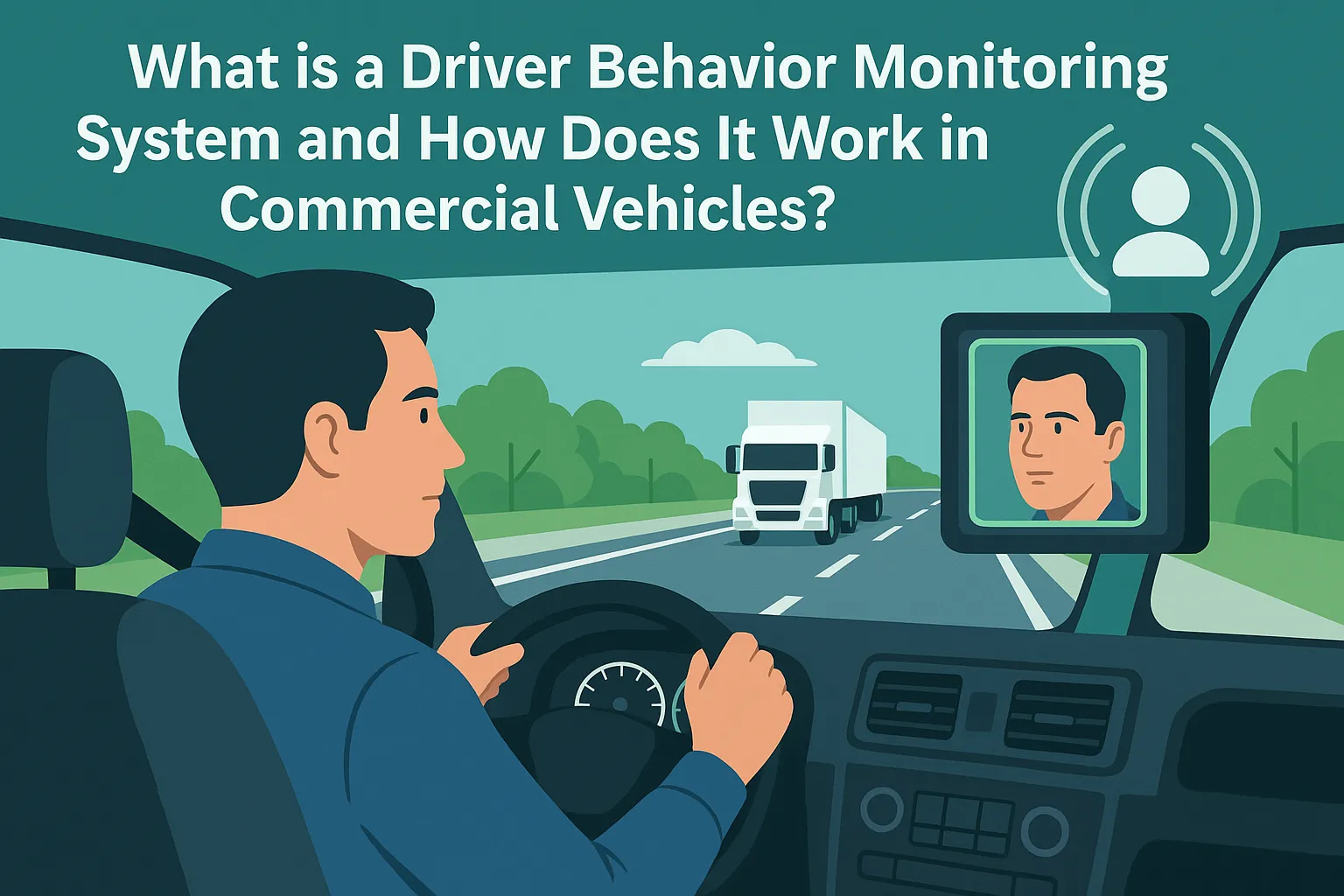
Driver safety is one of the most important concerns for commercial fleets. Trucks, buses, delivery vans, taxis, construction vehicles, and logistics vehicles often operate for long hours and in complex road environments. Even experienced drivers may become tired, distracted, or inattentive during daily operation.
A driver behavior monitoring system helps fleets reduce these risks by using an in-cabin AI camera to monitor the driver’s condition in real time. When unsafe behaviors such as fatigue, distraction, phone use, smoking, or driver absence are detected, the system can trigger an immediate warning to remind the driver and help prevent accidents.
For fleet operators, a driver behavior monitoring system is not only a camera device. It is also a practical tool for driver safety management, accident prevention, driver training, and long-term fleet operation improvement.
For fleet operators who need both road video recording and driver behavior detection, an AI dash cam with DMS and ADAS can provide a more complete safety solution for commercial vehicles.
What Is a Driver Behavior Monitoring System?
A driver behavior monitoring system, also known as a Driver Monitoring System (DMS), is an AI-based vehicle safety system designed to monitor the driver inside the vehicle cabin.
Unlike a traditional dash cam that mainly records the road ahead, a DMS camera focuses on the driver. It analyzes the driver’s face, eyes, head movement, hand movement, and body posture to determine whether the driver is alert and focused on driving.
In commercial vehicles, a driver behavior monitoring system is commonly used together with:
- AI dash cams
- 4G vehicle DVR systems
- ADAS cameras
- GPS tracking systems
- Fleet management platforms
- Cloud video monitoring software
A complete DMS solution helps fleet managers understand not only where the vehicle is, but also how safely the vehicle is being driven.
For fleet projects that need a ready-to-integrate DMS configuration, VisionSafetys provides a dedicated driver behavior monitoring system solution for trucks, buses, and commercial vehicle applications.
Why Commercial Fleets Need Driver Behavior Monitoring
Commercial vehicles usually have higher operating risks than private cars. They may drive longer distances, carry heavier loads, work at night, stop frequently, or operate in crowded environments.
For example, a logistics truck driver may drive for many hours each day. A bus driver needs to pay attention to road conditions, passengers, stops, and traffic at the same time. A construction vehicle operator may work in an environment with pedestrians, machinery, dust, vibration, and limited visibility.
In these situations, unsafe driver behavior can quickly lead to serious accidents.
Common safety risks include:
- Driver fatigue
- Looking away from the road
- Using a mobile phone while driving
- Smoking while driving
- Not wearing a seat belt
- Leaving the driver seat
- Blocking or covering the camera
- Inattention during low-speed operation
A driver behavior monitoring system helps detect these risks early and reminds the driver before the situation becomes more dangerous.
What Driver Behaviors Can a DMS Detect?
A professional AI DMS camera can detect different types of risky driver behavior, depending on the system configuration and algorithm.
1. Fatigue and Drowsiness Detection
Driver fatigue is one of the most common risks in commercial vehicle operation. Long working hours, night driving, repetitive routes, and insufficient rest may all increase fatigue risk.
A DMS camera can detect signs of fatigue such as:
- Closed eyes
- Frequent blinking
- Yawning
- Head nodding
- Slow reaction posture
- Long-time eye closure
When fatigue behavior continues for a certain period, the system can trigger a local alarm to remind the driver to stay alert or take a rest.
2. Distracted Driving Detection
Distracted driving happens when the driver’s attention is not focused on the road. This may include looking sideways, looking down, talking to passengers, checking objects inside the cabin, or being distracted by other devices.
A driver behavior monitoring system can detect when the driver looks away from the road for too long. Once distraction is recognized, the system can generate an alert to help the driver refocus.
3. Phone Use Detection
Using a mobile phone while driving is a common cause of distraction. In commercial fleets, phone use can be especially risky because drivers often operate large vehicles with longer braking distances and larger blind spots.
A DMS camera can detect phone use behavior and remind the driver immediately. Fleet managers can also review phone-use alarm events through the management platform if the system supports 4G data upload.
4. Smoking Detection
Some fleet operators need to prevent smoking inside vehicles for safety, hygiene, or company policy reasons.
A driver behavior monitoring system can detect smoking behavior and create an alarm event. This function is useful for buses, taxis, delivery fleets, fuel vehicles, and company-managed commercial vehicles.
5. Driver Absence Detection
Driver absence detection can identify whether the driver is missing from the seat or not properly positioned in the driving area.
This function is useful for commercial vehicles that require continuous driver monitoring, such as buses, taxis, logistics vehicles, and special-purpose vehicles.
6. Camera Blocking Detection
For AI monitoring to work properly, the camera must have a clear view of the driver. If the camera is covered, blocked, moved, or intentionally obstructed, the system may not be able to detect driver behavior correctly.
Camera blocking detection helps fleet managers know whether the DMS camera is working normally.
7. Sunglasses and Face Covering Detection
Some DMS systems can also identify situations where sunglasses, masks, or other objects affect facial recognition and behavior detection.
This does not always mean the driver is doing something wrong, but it helps the system understand whether detection accuracy may be affected.
8. Seat Belt Status Detection
Seat belt detection helps fleet operators improve driver compliance and reduce operational risk.
For commercial fleets, seat belt behavior is an important part of driver safety management. A DMS system with seat belt detection can remind the driver and record non-compliance events.
How Does a Driver Behavior Monitoring System Work?
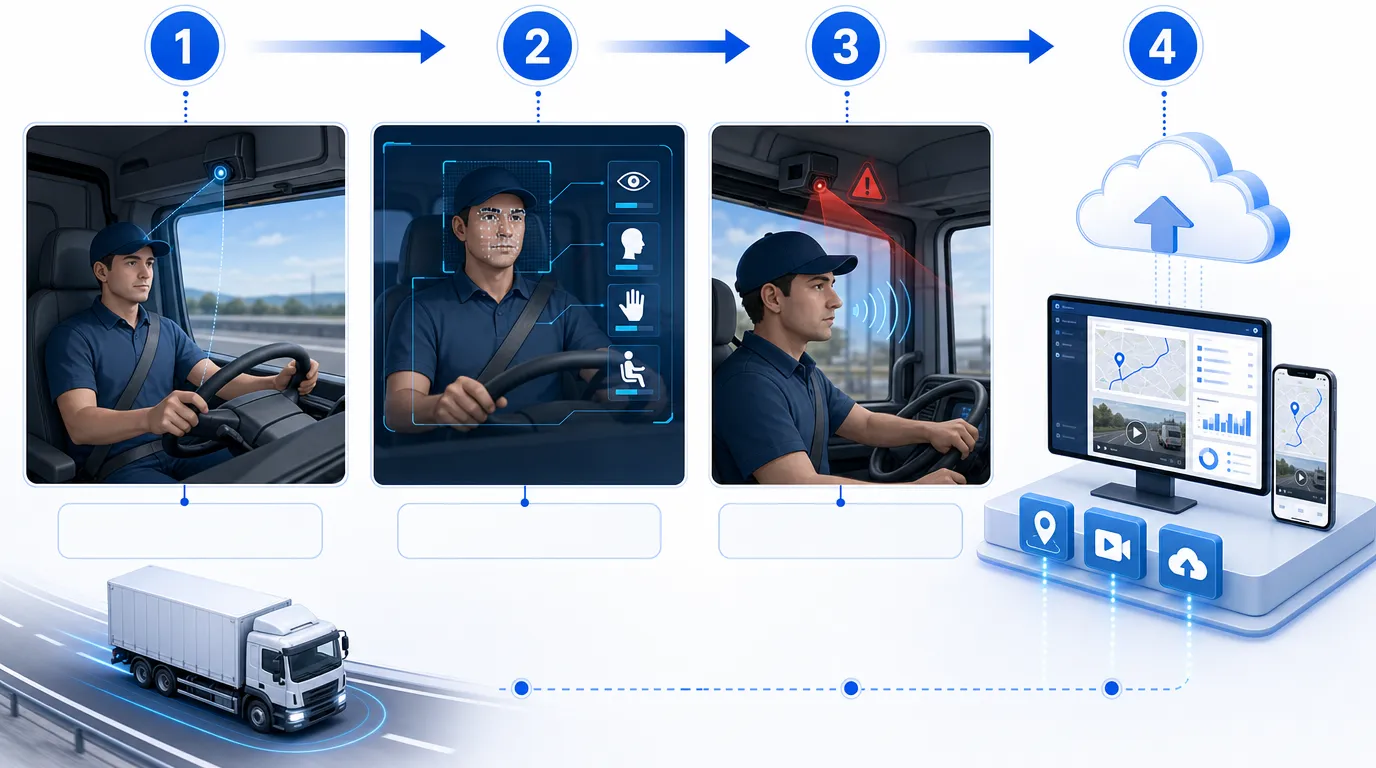
A driver behavior monitoring system usually works through four main steps.
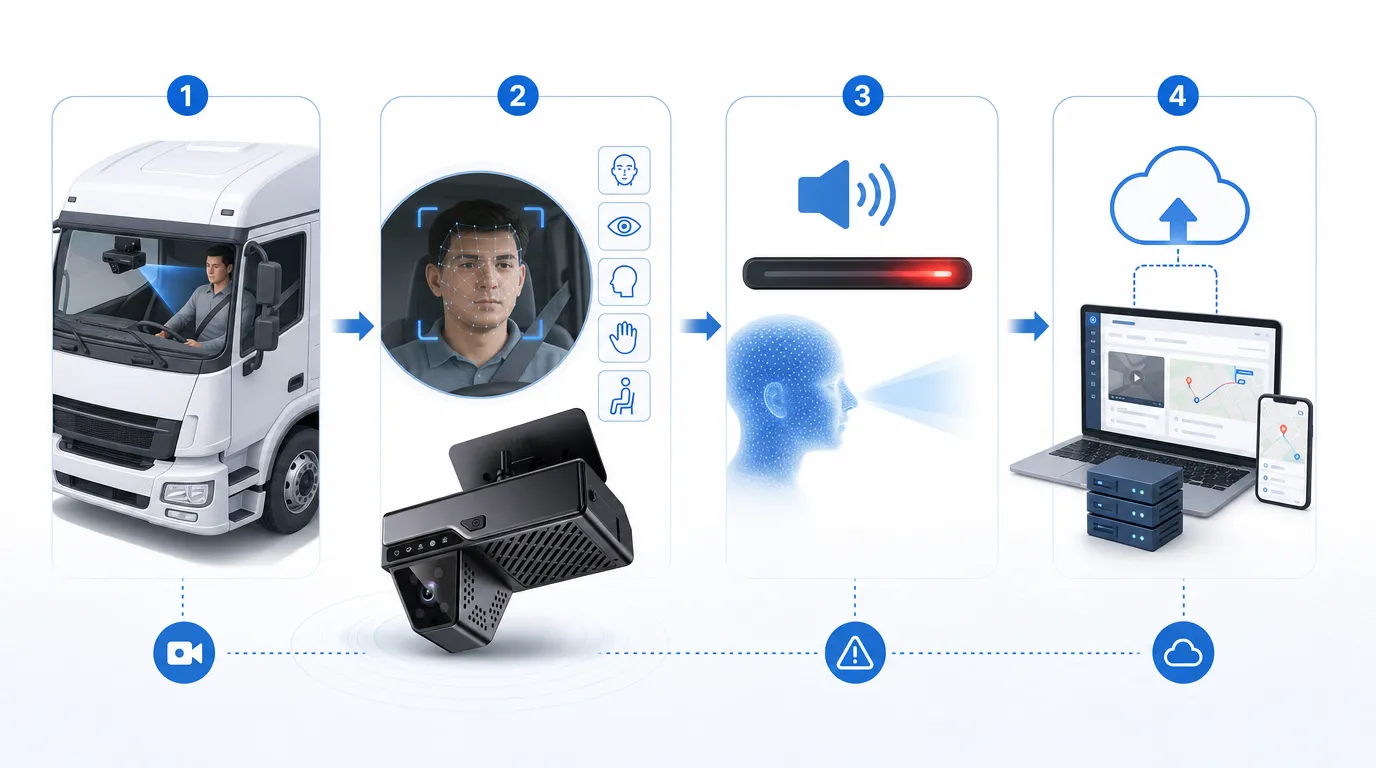
Step 1: The In-Cabin Camera Captures Driver Images
The DMS camera is installed inside the vehicle cabin. It is usually mounted on the dashboard, windshield area, or A-pillar, depending on the vehicle type and cabin layout.
The camera should have a clear view of the driver’s face, eyes, upper body, and hand movements.
Many DMS cameras support infrared or low-light imaging, so they can monitor the driver even at night or in dark cabin conditions.
Step 2: AI Algorithm Analyzes Driver Behavior
The system analyzes the driver’s image in real time. AI algorithms check the driver’s facial features, eye status, mouth movement, head direction, hand movement, and body posture.
Instead of simply recording video, the system understands whether the driver may be tired, distracted, smoking, using a phone, or not paying attention.
Step 3: The System Triggers a Real-Time Warning
When unsafe behavior is detected, the system can trigger a warning inside the vehicle.
Common warning methods include:
- Voice alarm
- Beep sound
- Warning light
- On-screen alert
- Zumbador externo
- Platform alarm notification
The purpose is to remind the driver immediately before the risky behavior leads to an accident.
Step 4: Event Data Is Uploaded to the Fleet Platform
For 4G AI dash cam systems, DMS alarm events can be uploaded to a fleet management platform.
The uploaded event may include:
- Alarm type
- Time
- GPS location
- Vehicle speed
- Driver image
- Video clip
- Vehicle information
- Driver ID or facial recognition result
Fleet managers can use this data to review unsafe driving behavior, improve driver training, and manage fleet safety more efficiently.
DMS vs ADAS vs Traditional Dash Cam
Many people confuse DMS, ADAS, and traditional dash cams. They are related, but their functions are different.
| System Type | Main Monitoring Area | Main Function | Typical Use |
|---|---|---|---|
| Traditional Dash Cam | Road or vehicle surroundings | Video recording | Accident evidence |
| DMS | Driver inside the cabin | Driver behavior detection | Fatigue, distraction, phone use, smoking |
| ADAS | Road outside the vehicle | Road risk detection | Lane departure, forward collision, pedestrian warning |
A traditional dash cam mainly records video. It is useful after an accident because it provides evidence.
A DMS camera monitors the driver and provides real-time warnings when unsafe behavior is detected.
ADAS monitors the road ahead and warns the driver of external risks, such as lane departure, forward collision, or pedestrian danger.
For commercial fleets, the best solution is often a combination of all three: road-facing video recording, driver-facing DMS, and road-risk detection with ADAS.
In many fleet projects, DMS and ADAS can be integrated into one AI dash cam with ADAS and DMS, helping fleet operators monitor both the road environment and the driver’s behavior.
How DMS and ADAS Work Together
DMS and ADAS can create a more complete vehicle safety solution.
ADAS monitors the road outside the vehicle, while DMS monitors the driver inside the cabin. When these two systems work together, the fleet can understand both the external road risk and the driver’s condition.
For example:
- ADAS detects a forward collision risk.
- DMS detects that the driver is distracted.
- The system triggers a stronger warning.
- The event is recorded and uploaded to the platform.
- The fleet manager can review the video and driver behavior data later.
This combination is especially useful for trucks, buses, taxis, logistics vehicles, and long-distance transport fleets.
Common Installation Positions in Commercial Vehicles
The installation position of the DMS camera is very important. If the camera angle is not correct, detection accuracy may be affected.
In most commercial vehicles, the DMS camera can be installed in one of the following positions:
- Dashboard
- Windshield area
- A-pillar
- Near the rearview mirror
- Monitor bracket area
- Customized cabin mounting position
The camera should face the driver clearly and avoid being blocked by the steering wheel, sun visor, dashboard decoration, or other cabin accessories.
For trucks and buses, it is recommended to test the camera position on one vehicle first before large-scale fleet installation. This helps confirm the best camera angle and reduces possible false alarms.
If you are planning a multi-camera fleet project, you may also want to read our truck camera placement guide to better understand camera mounting positions.
What May Affect DMS Detection Accuracy?
A good driver behavior monitoring system should not only detect risky behaviors, but also reduce unnecessary false alarms.
In real vehicle use, DMS detection accuracy may be affected by:
- Incorrect camera angle
- Strong sunlight
- Night reflection
- Driver wearing sunglasses
- Driver wearing a face mask
- Poor cabin lighting
- Camera blocked by objects
- Driver sitting too far from the camera
- Vehicle vibration
- Improper calibration
Before deploying the system across a fleet, it is recommended to test the DMS camera in real driving conditions, including daytime, nighttime, tunnel driving, and different driver seating positions.
This helps ensure more stable detection performance and better driver acceptance.
Main Benefits of Driver Behavior Monitoring for Fleet Operators
1. Reduce Accident Risk
Real-time alerts help drivers correct unsafe behavior immediately. This is especially valuable for long-distance driving, night driving, heavy-duty trucks, buses, and high-frequency delivery vehicles.
2. Improve Driver Training
Fleet managers can use DMS alarm records to understand common driver behavior problems.
For example, if a driver frequently triggers fatigue alarms or phone-use alarms, the company can provide targeted training instead of general safety reminders.
3. Support Accident Investigation
When an accident or near-miss happens, recorded video and driver behavior data can help clarify what happened before the incident.
The system can provide useful information such as whether the driver was distracted, tired, using a phone, or looking away from the road.
4. Improve Fleet Safety Management
DMS data can become part of a company’s safety management system.
Fleet operators can track unsafe behavior trends, compare driver performance, and build better safety rules based on real driving data.
5. Reduce Long-Term Operating Costs
Unsafe driving behavior may lead to accidents, vehicle damage, insurance claims, vehicle downtime, customer complaints, and higher management costs.
By reducing risky behavior, a driver behavior monitoring system can help fleets lower long-term operating risk.
For fleet managers who want to understand how camera systems can reduce accidents, downtime, and insurance-related costs, this article on fleet camera system ROI may also be helpful.
Which Vehicles Can Use a Driver Behavior Monitoring System?
Driver behavior monitoring systems are suitable for many types of commercial and industrial vehicles, including:
- Heavy-duty trucks
- Logistics trucks
- Delivery vans
- Buses and coaches
- School buses
- Taxis
- Ride-hailing vehicles
- Construction vehicles
- Mining vehicles
- Forklifts
- Industrial vehicles
- Emergency service vehicles
- Fuel tankers
- Special-purpose vehicles
For vehicles that operate for long hours, carry passengers, transport valuable goods, or work in high-risk environments, DMS is especially useful.
For logistics and heavy-duty truck applications, DMS can also work together with truck camera systems for commercial fleets to improve driver safety, external visibility, and overall fleet monitoring.
How to Choose a Driver Behavior Monitoring System
When selecting a DMS solution for commercial vehicles, fleet operators should consider several important factors.
1. Detection Functions
Different DMS systems may support different detection functions. For fleet safety applications, common functions include fatigue detection, distraction detection, phone use detection, smoking detection, driver absence detection, camera blocking detection, and seat belt detection.
Before choosing a system, fleet operators should confirm which behaviors need to be monitored.
2. Detection Accuracy
Detection accuracy is very important. A system with too many false alarms may annoy drivers and reduce acceptance. A system that misses too many risky behaviors may not provide enough safety value.
A good DMS system should balance accurate detection with reasonable alarm sensitivity.
3. Night Vision Performance
Many commercial vehicles operate at night. A DMS camera should support stable monitoring in low-light or dark cabin conditions.
Infrared or low-light imaging is important for trucks, buses, taxis, and logistics vehicles that run during nighttime operation.
4. Real-Time Alarm Function
The system should provide immediate local warnings when risky behavior is detected.
Possible alarm methods include voice warning, beep sound, warning light, screen alert, or external buzzer output.
For safety applications, real-time warning is more valuable than only recording video.
5. 4G and GPS Support
For fleet management, 4G and GPS functions are important.
With 4G connectivity, alarm events and video clips can be uploaded to the cloud platform. With GPS, fleet managers can check where the event happened and review the vehicle’s route, speed, and driving condition.
6. Platform Compatibility
A professional driver behavior monitoring system should support remote fleet management.
Useful platform functions may include:
- Live video monitoring
- GPS tracking
- Alarm event search
- Video playback
- Driver behavior reports
- Vehicle status management
- Remote configuration
- Multi-vehicle fleet monitoring
7. Vehicle-Grade Hardware Reliability
Commercial vehicles may face vibration, heat, cold, dust, humidity, and unstable power conditions.
A DMS solution should use reliable vehicle-grade hardware with stable power input, durable connectors, and long-term operating stability.
8. Easy Installation and Maintenance
For fleet retrofit projects, installation efficiency is important.
A compact camera design, simple wiring, clear installation guide, and flexible mounting options can reduce labor cost and installation time.
VisionSafetys 4G AI Dash Cam with DMS Function
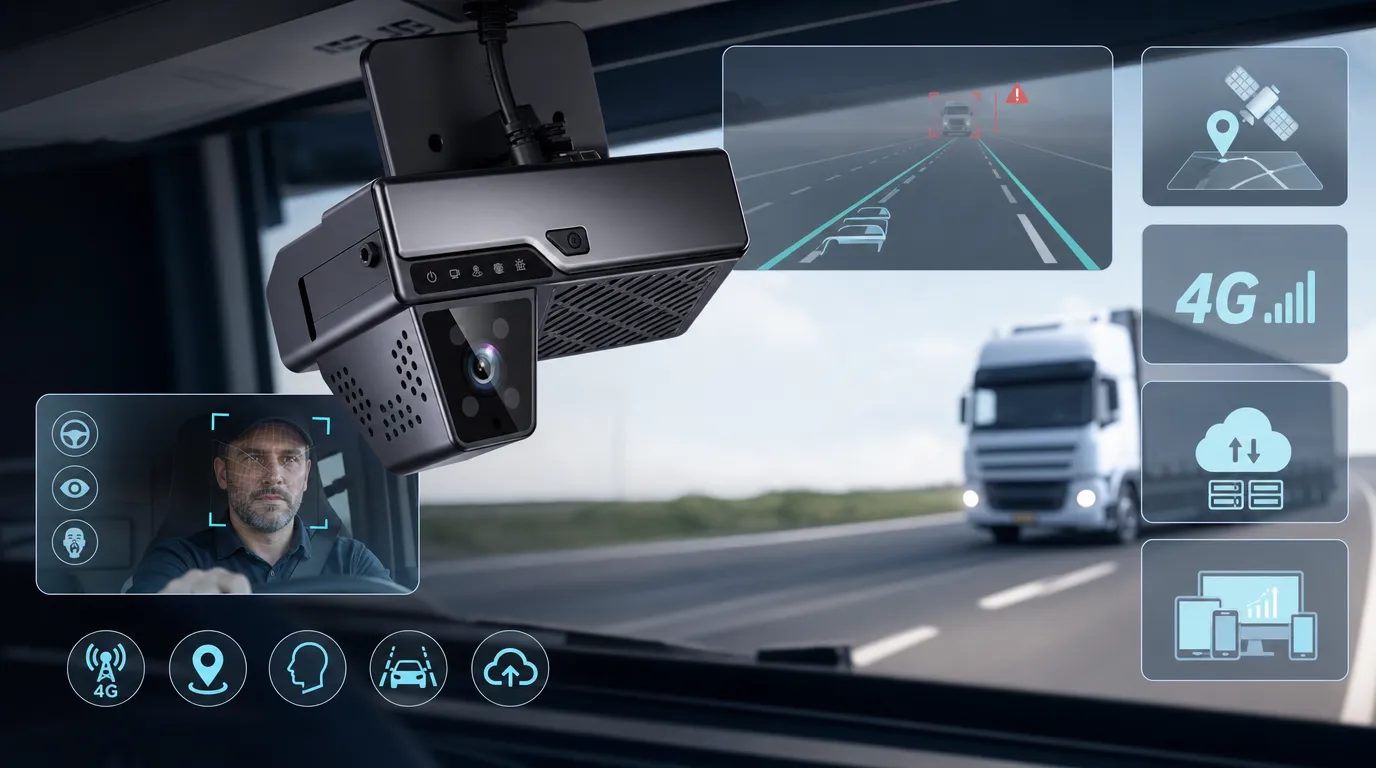
VisionSafetys provides commercial vehicle safety solutions, including AI dash cams, DMS cameras, ADAS systems, vehicle DVR systems, and fleet camera monitoring solutions.
Our 4G AI Dash Cam is designed for commercial fleet safety applications. It supports 4-channel HD monitoring, built-in 4G, WiFi, GPS, dual TF card storage, and AI functions including ADAS, DMS, and facial recognition.
For driver behavior monitoring, the system can support detection functions such as:
- Smoking detection
- Phone use detection
- Yawning detection
- Drowsiness detection
- Distracted driving detection
- Driver not detected
- Camera blocking detection
- Sunglasses detection
- Seat belt status detection
Alarm events can be combined with GPS location, video recording, and fleet management platform data. This helps fleet operators review risky driving behavior, improve driver training, and manage vehicles more efficiently.
For fleet projects, VisionSafetys can provide suitable configurations based on vehicle type, installation requirements, camera channel needs, platform requirements, and target application scenarios.
Learn more about our 4G AI Dash Cam with DMS and ADAS.
Driver Behavior Monitoring System for Different Applications
Truck Fleets
For long-distance trucks and logistics vehicles, fatigue and distraction are common safety risks. A DMS system can help detect drowsiness, phone use, smoking, and abnormal driver behavior during long driving periods.
Bus and Coach Fleets
Buses carry many passengers, so driver safety is extremely important. DMS can help monitor driver attention and reduce risks caused by fatigue or distraction.
Taxi and Ride-Hailing Vehicles
Taxi and ride-hailing drivers often work long hours in urban traffic. Driver behavior monitoring can help improve service safety and provide event records for fleet operators.
Construction and Mining Vehicles
Construction and mining vehicles often operate in complex environments with workers, machines, dust, and limited visibility. DMS can be used together with external camera systems to improve overall safety.
Delivery Vans
Delivery drivers may stop frequently, check routes, and operate under time pressure. A DMS system can help reduce distraction and improve safe driving habits.
Preguntas frecuentes
What is a driver behavior monitoring system?
A driver behavior monitoring system is an AI-based vehicle safety system that uses an in-cabin camera to monitor the driver’s condition and detect unsafe behaviors such as fatigue, distraction, phone use, smoking, and abnormal posture.
How does a DMS camera detect driver fatigue?
A DMS camera analyzes the driver’s eyes, face, mouth, head movement, and posture. If the system detects signs such as closed eyes, yawning, or head nodding, it can trigger a warning.
Can a driver behavior monitoring system work at night?
Yes. Many professional DMS cameras support infrared or low-light imaging, allowing them to monitor the driver in dark cabin conditions.
What is the difference between DMS and ADAS?
DMS monitors the driver inside the vehicle, while ADAS monitors the road outside the vehicle. DMS detects driver fatigue, distraction, phone use, and smoking. ADAS detects external road risks such as lane departure, forward collision, and pedestrian danger.
Is DMS suitable for trucks and buses?
Yes. DMS is suitable for trucks, buses, vans, taxis, coaches, school buses, construction vehicles, and other commercial vehicles.
Can DMS alarm events be uploaded to a fleet platform?
Yes. When used with a 4G AI dash cam or vehicle DVR, DMS alarm events, video clips, GPS location, and driver behavior data can be uploaded to a fleet management platform.
Does DMS replace a traditional dash cam?
No. DMS and traditional dash cams have different functions. A traditional dash cam records road video, while DMS monitors driver behavior. For fleet safety, they are often used together.
What should be checked before installing a DMS camera?
Before installation, it is important to check the camera angle, driver seating position, cabin lighting, windshield reflection, wiring route, power supply, and whether the camera view may be blocked by the steering wheel or other objects.
Conclusión
A driver behavior monitoring system is an important safety solution for commercial fleets. By using an in-cabin AI camera to detect fatigue, distraction, phone use, smoking, driver absence, camera blocking, and other unsafe behaviors, the system helps drivers stay alert and helps fleet operators manage safety more effectively.
Compared with a traditional dash cam, DMS provides real-time driver behavior analysis and immediate alerts. When combined with ADAS, GPS, 4G video upload, and fleet management software, it becomes a more complete safety solution for trucks, buses, vans, taxis, logistics vehicles, and other commercial vehicles.
For fleet operators, DMS is not only about recording what happened after an accident. It is about detecting risky behavior earlier, improving driver habits, reducing accidents, and building a safer fleet operation.
If you are looking for a reliable driver behavior monitoring system or 4G AI dash cam solution for your commercial vehicle project, VisionSafetys can help you choose a suitable configuration based on your vehicle type, installation requirements, platform needs, and fleet safety goals.
Contact VisionSafetys to learn more about our commercial vehicle DMS and AI dash cam solutions.