
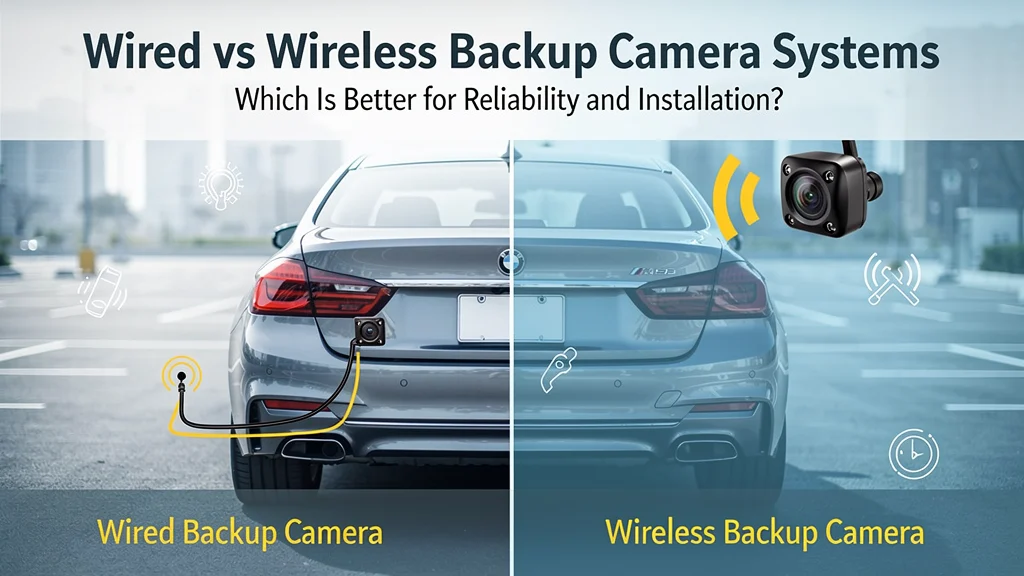
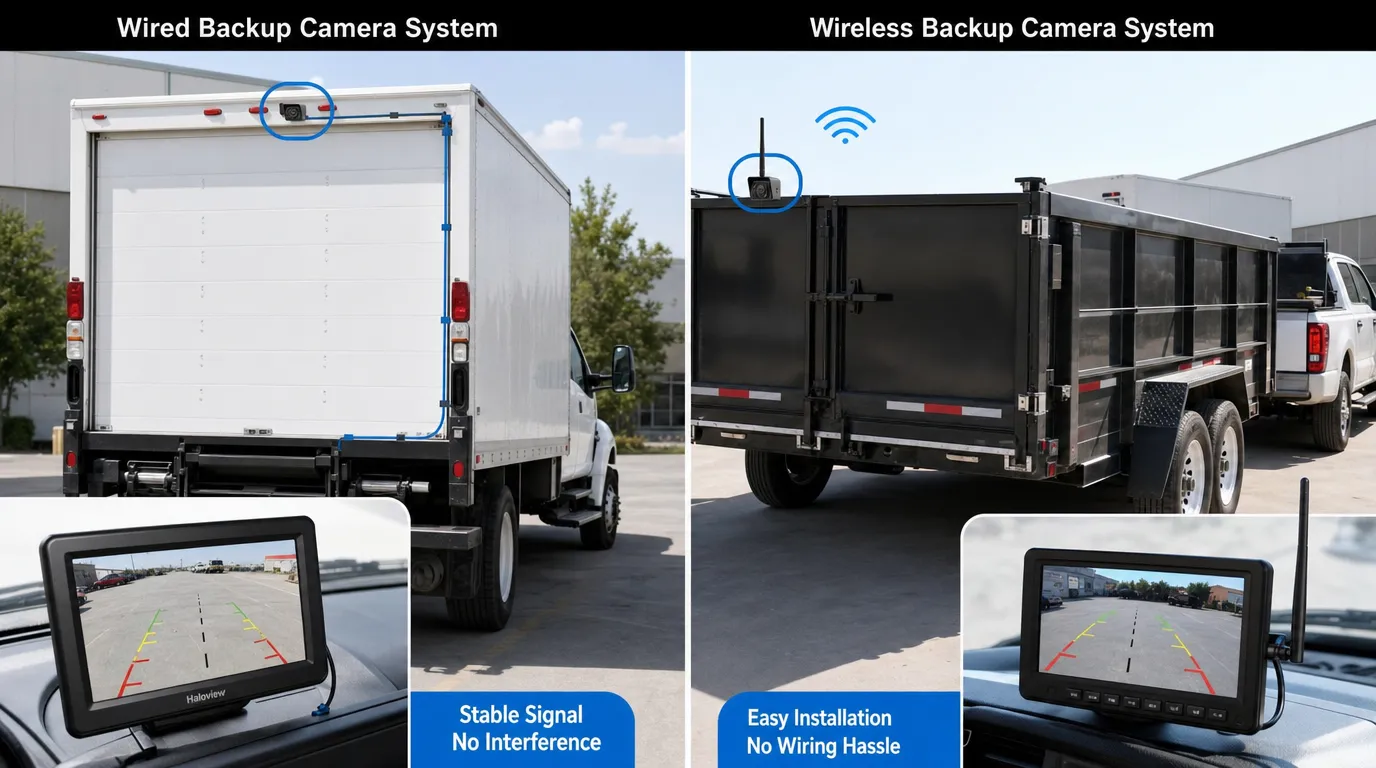
Choosing between a wired and wireless backup camera system is not only about installation difficulty. For trucks, trailers, forklifts, construction vehicles, vans, and commercial fleets, the bigger question is whether the system can provide a stable rear-view image every day.
For daily-use commercial vehicles, a wired backup camera system is usually the safer default choice because it provides more stable video transmission, lower delay risk, and fewer signal-related problems after proper installation.
A wireless backup camera system is usually better when faster installation, trailer use, temporary setup, or reduced cable routing is more important than maximum signal stability.
This guide compares wired vs wireless backup cameras from a practical commercial vehicle perspective, including reliability, installation time, video delay, signal loss, vehicle type, common problems, and how to choose the right system.
Quick Answer: Wired or Wireless Backup Camera?
A wired backup camera system is usually better for commercial vehicles that need stable daily operation, long-term reliability, low delay, and low interference risk.
A wireless backup camera system is usually better when faster installation, trailer use, temporary setup, or easier retrofit is more important than maximum signal stability.
In simple terms:
| If you need... | Better choice |
|---|---|
| Maximum signal stability | Wired backup camera |
| Long-term commercial vehicle use | Wired backup camera |
| Lower delay risk | Wired backup camera |
| Lower interference risk | Wired backup camera |
| Faster installation | Wireless backup camera |
| Easier retrofit | Wireless backup camera |
| Trailer or detachable setup | Wireless backup camera |
| Temporary or flexible use | Wireless backup camera |
The best choice depends on your vehicle type, installation conditions, working environment, and how much the driver depends on the camera during daily operation.
For a complete overview of rear-view systems, you can also read our backup camera systems guide.
Which Backup Camera System Should You Choose?
If you want a quick decision before reading the full comparison, use the table below.
| Your Situation | Recommended Choice |
|---|---|
| Daily-use truck or fleet vehicle | Wired backup camera |
| Long vehicle with heavy daily operation | Wired backup camera |
| Safety-critical reversing with low tolerance for delay | Wired backup camera |
| Forklift working in busy warehouse areas | Wired backup camera, if cable routing is possible |
| Construction vehicle in harsh environments | Wired backup camera |
| Trailer or detachable vehicle setup | Wireless or battery-powered wireless backup camera |
| Temporary installation or rental vehicle | Wireless backup camera |
| Fast retrofit with limited downtime | Wireless backup camera |
| Vehicle where cable routing is very difficult | Wireless backup camera |
For most commercial vehicles used every day, wired is the more reliable choice. For trailers, temporary setups, rental vehicles, and fast retrofit projects, wireless can be the more practical choice.
Wired vs Wireless Backup Cameras at a Glance
Before choosing a system, it helps to compare the two options side by side.
| Factor | Wired Backup Camera | Wireless Backup Camera |
|---|---|---|
| Signal stability | Usually stronger | More dependent on environment |
| Installation time | Usually longer | Usually shorter |
| Cable routing | More required | Less required |
| Interference risk | Lower | Higher |
| Video delay risk | Lower | Possible in some systems |
| Best for daily commercial use | Yes | Case-dependent |
| Best for fast retrofit | Less convenient | More suitable |
| Best for trailers | Possible, but more wiring needed | Often more practical |
| Long-term reliability | Usually better | Depends on product and installation |
| Maintenance focus | Cable and connectors | Signal, antenna, and power supply |
This does not mean wired is always better or wireless is always weak. Each system solves a different problem. Wired systems reduce signal uncertainty, while wireless systems reduce installation work.
What Is a Wired Backup Camera System?
A wired backup camera system sends the camera image to the monitor through a physical video cable. In many commercial vehicle installations, the camera is mounted at the rear of the vehicle, and the cable is routed along the vehicle body to the monitor in the cab.
Wired backup camera systems are commonly used for:
- Trucks
- Forklifts
- Construction vehicles
- Vans and work vehicles
- Buses and service vehicles
- Long-term fixed installations
- Commercial vehicles used every day
The main advantage of a wired system is predictability. Once installed properly, the video signal is usually stable and consistent.
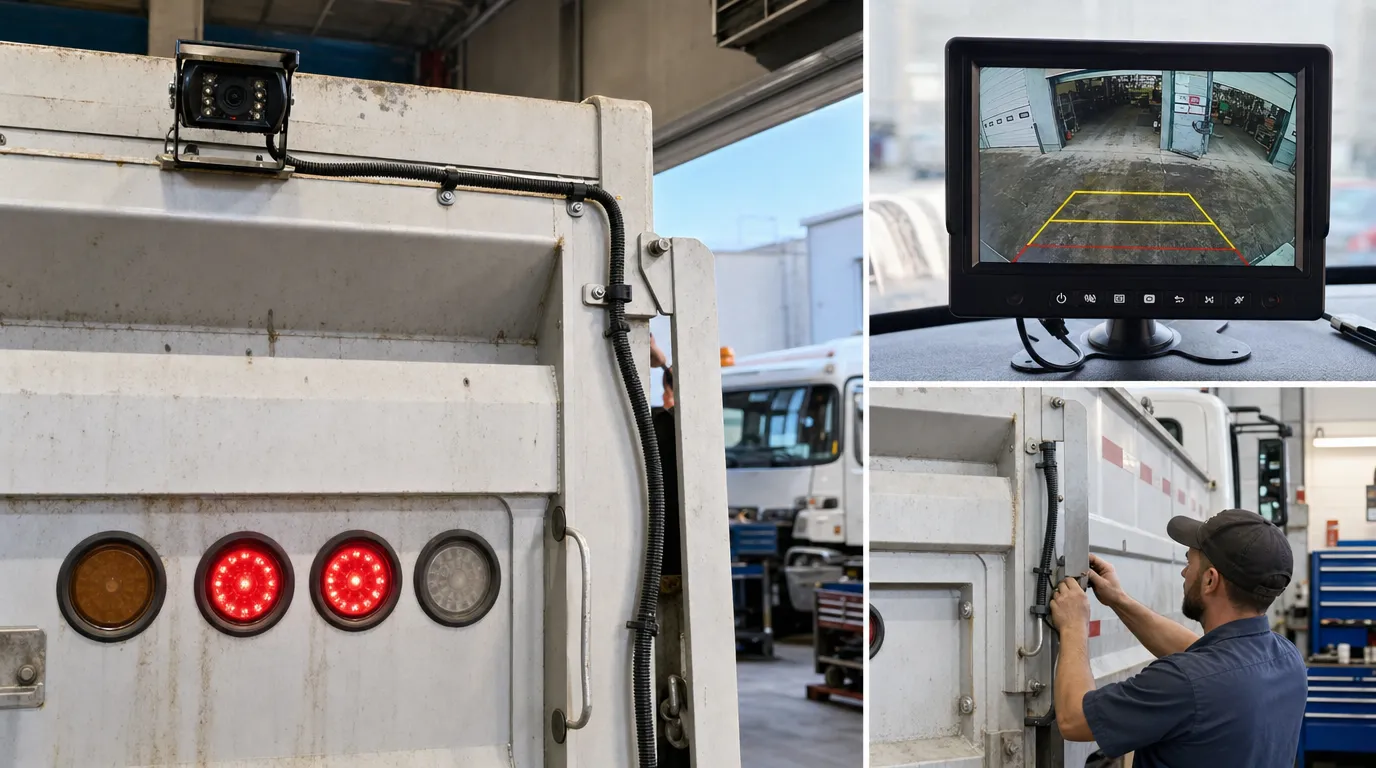
Main Advantages of Wired Backup Cameras
Wired backup cameras are often preferred when reliability matters more than installation speed.
Main advantages include:
- Stable video transmission
- Lower risk of wireless interference
- More consistent image quality
- Lower risk of video delay
- Better performance for long-term use
- Suitable for demanding commercial environments
- Less affected by surrounding vehicles, buildings, metal structures, or electronic equipment
For vehicles that reverse frequently or operate for long hours every day, this stability can be more important than saving installation time.
Common Limitations of Wired Backup Cameras
The main disadvantage of a wired backup camera is installation work.
Common limitations include:
- Longer installation time
- More cable routing
- More labor cost during retrofit
- Harder installation on long vehicles
- Possible cable damage if routing is poor
- More attention needed around hinges, tailgates, doors, and moving parts
A wired system can be very reliable, but installation quality still matters. Poor cable routing, weak connectors, or exposed cable sections can still cause image loss or intermittent signal problems later.
What Is a Wireless Backup Camera System?
A wireless backup camera system transmits the video signal wirelessly from the camera to the monitor. The camera still needs power, but the long video cable route from the rear of the vehicle to the cab is reduced or removed.
Wireless backup camera systems are often used for:
- Trailers
- Temporary installations
- Rental fleets
- Quick retrofit projects
- Detachable vehicle setups
- Vehicles where cable routing is difficult
- Applications where downtime must be minimized
The main advantage of wireless is installation convenience. In many cases, it can reduce installation time and make the system easier to add to an existing vehicle.
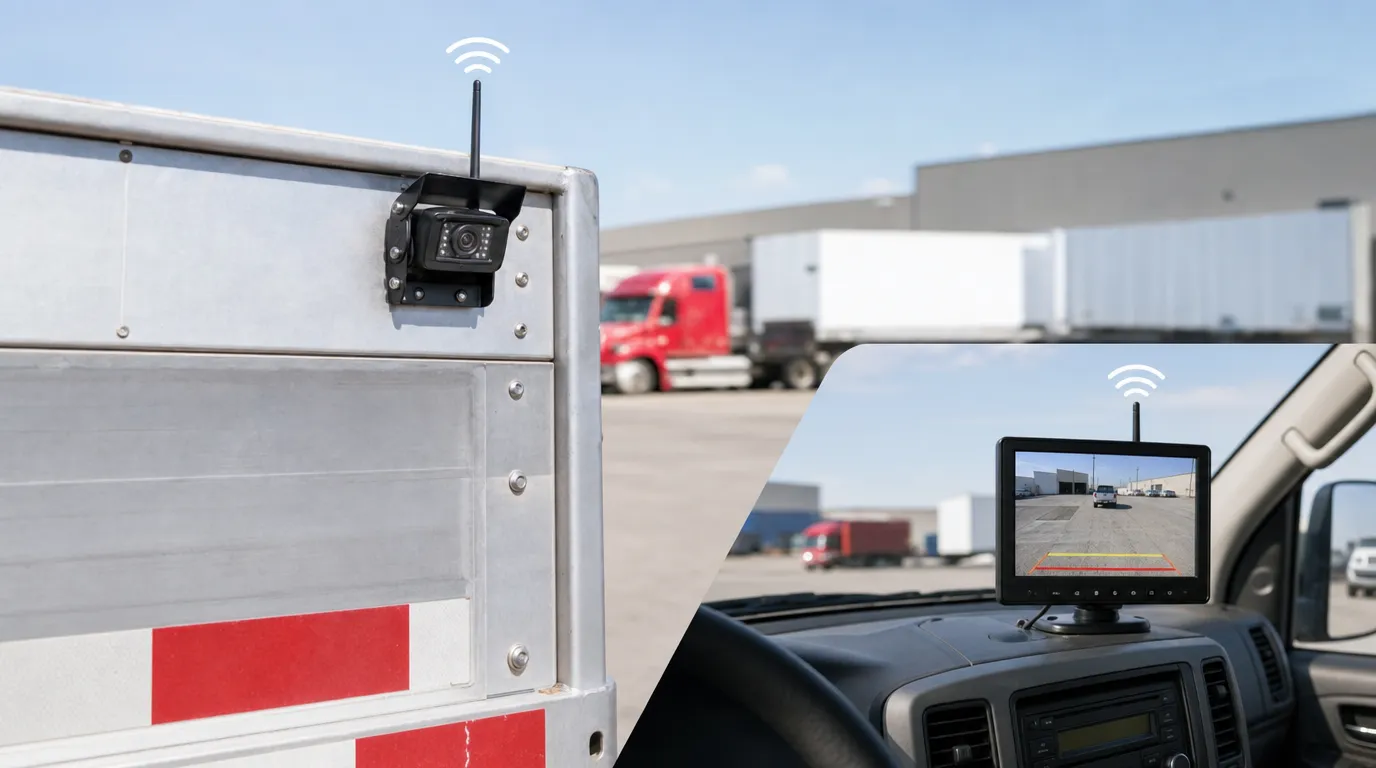
Main Advantages of Wireless Backup Cameras
Wireless backup cameras are useful when installation flexibility is important.
Main advantages include:
- Faster installation
- Less cable routing
- Easier retrofit
- Suitable for some trailer applications
- Easier to remove or relocate
- Useful when vehicle downtime must be reduced
For trailers, temporary vehicle setups, or retrofit projects, wireless can be the more practical choice.
Common Limitations of Wireless Backup Cameras
Wireless backup cameras are convenient, but they depend more on signal conditions.
Common limitations include:
- Possible signal interference
- Possible video delay
- Shorter stable transmission distance in difficult environments
- More sensitivity to vehicle structure
- More dependence on antenna position
- Greater performance difference between different product designs
A wireless system can work well, but it should be selected carefully for commercial vehicles. Vehicle length, operating environment, mounting position, signal path, and antenna layout all matter.
The Real Difference: Reliability vs Installation Convenience
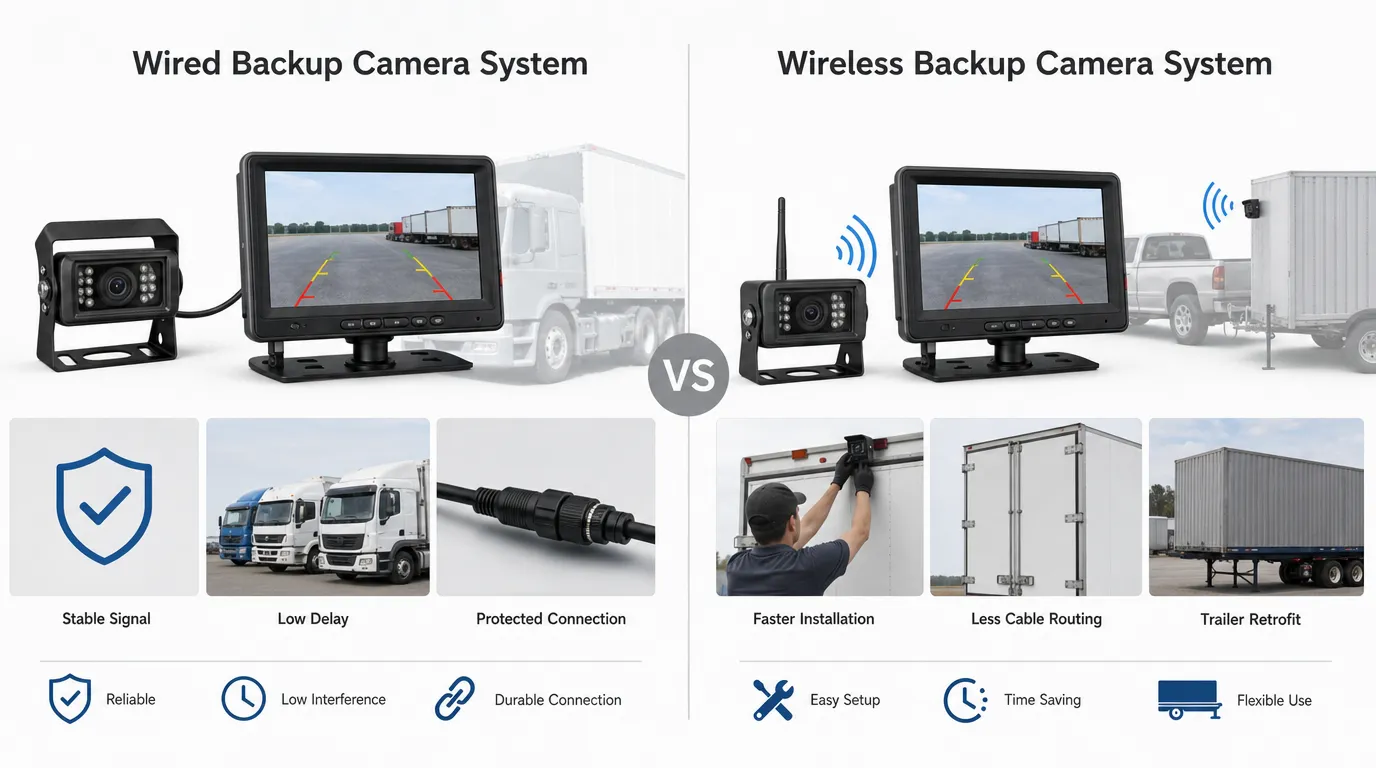
The main difference between wired and wireless backup camera systems is simple:
- Wired systems reduce signal uncertainty.
- Wireless systems reduce installation work.
For many buyers, the decision is not about which technology sounds better. The real question is which trade-off is more acceptable in daily use.
Choose a wired backup camera if:
- The vehicle is used every day
- The camera image must be stable
- The installation is permanent
- The vehicle is large or heavy-duty
- Signal loss would create safety or operating problems
- The driver relies heavily on the rear-view image
Choose a wireless backup camera if:
- Installation time must be reduced
- Long cable routing is difficult
- The vehicle setup is temporary or flexible
- The system is used on a trailer
- Retrofit convenience matters more than maximum signal stability
- The camera may need to be removed or relocated later
This is why wired backup cameras are often the safer long-term choice for commercial vehicles, while wireless backup cameras are often the easier choice for fast installation.
Signal Stability: Why Wired Usually Wins
When signal stability is the top priority, wired backup camera systems usually have the advantage.
Because the image is transmitted through a physical cable, the system is less likely to be affected by wireless interference, pairing problems, or signal drop. This is especially important in commercial environments where vehicles may operate near buildings, containers, warehouses, cranes, machinery, metal structures, or other electronic equipment.
Stable video transmission matters most when:
- The vehicle reverses frequently
- The driver relies heavily on the camera
- The working area is busy or narrow
- The system is used every day
- The vehicle is long or heavy-duty
- A delayed or unstable image could affect safety
A wired system does not automatically guarantee perfect performance, but it usually gives fewer transmission surprises after proper installation.
Installation Time: Why Wireless Often Wins
Wireless backup cameras are often chosen because they reduce installation labor.
Without a full video cable run from the rear camera to the display, installation can become faster and less disruptive. This can be useful for vehicles that are already in service and cannot be taken out of operation for a long time.
Wireless installation is especially useful when:
- Retrofit time is limited
- Cable routing is difficult
- Multiple vehicles need a fast upgrade
- The setup is temporary or semi-permanent
- The system may need to be removed later
- The vehicle has a trailer or detachable section
However, faster installation does not mean no installation work. A wireless backup camera still needs proper power supply, camera mounting, monitor placement, antenna position, and trigger setup.
If the vehicle is long, the environment is complex, or the camera is used heavily every day, installation convenience should be balanced against signal reliability.
If you already have a wired system and want to reduce cable routing, you can also read our guide on how to convert a wired backup camera to wireless.
Wired vs Wireless Backup Cameras by Vehicle Type
The right choice depends heavily on vehicle type and real working conditions.
| Vehicle Type | Recommended Option | Reason |
|---|---|---|
| Trucks | Wired | Better for stable daily reversing and long-term use |
| Trailers | Wireless or battery-powered wireless | Easier connection between towing vehicle and trailer |
| Forklifts | Wired or wireless, depending on layout | Stability matters, but wiring space may be limited |
| Construction vehicles | Wired | Better for demanding and harsh working environments |
| Vans and pickup trucks | Wired for daily business use, wireless for easier retrofit | Depends on usage frequency and installation difficulty |
| Rental fleets | Wireless | Easier retrofit and flexible installation |
| Temporary use | Wireless | Faster deployment and easier removal |
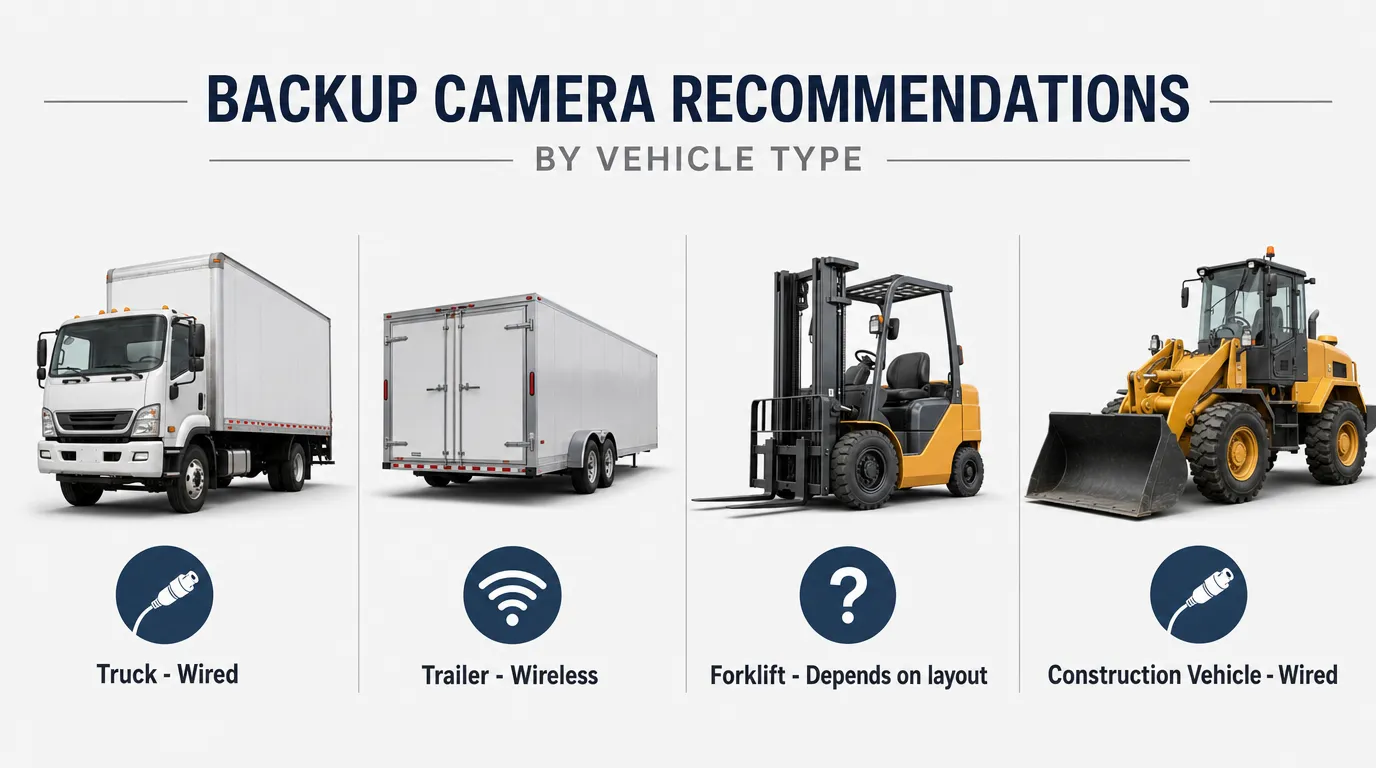
If you are choosing a backup camera system for trucks, trailers, forklifts, or commercial vehicles, the safest option is to confirm the vehicle length, installation layout, and working environment before deciding between wired and wireless.
VST can help you compare both options based on your vehicle type and installation conditions.
Ask for Backup Camera Recommendations
Wired Backup Cameras for Trucks and Commercial Vehicles
For trucks and commercial vehicles, wired backup camera systems are often preferred because they provide more stable video transmission for daily operation.
Commercial vehicles usually have higher demands than passenger cars. They may operate for longer hours, reverse more frequently, and work in more complex environments.
Wired systems are often a better fit when:
- The vehicle is used every day
- The camera is part of a long-term safety setup
- The driver needs a stable image during reversing
- The vehicle works in busy industrial or transport areas
- Installation can be done professionally
- The vehicle body or working environment may create wireless interference
For fleets, the extra installation work may be worthwhile because the system is expected to work reliably over a long period.
Wireless Backup Cameras for Trailers
Wireless backup cameras can be a better choice when wiring is difficult or when the vehicle setup is not fixed.
For trailers, cable routing between the towing vehicle and the trailer can be more complicated. In these situations, wireless systems can make installation easier and more flexible.
Wireless backup cameras are often suitable for:
- Trailers
- Detachable vehicle setups
- Temporary reversing assistance
- Fast retrofit projects
- Rental vehicles
- Applications where cable routing is not practical
For these use cases, wireless convenience may be more important than achieving the most stable possible signal.
However, trailer length, antenna position, power supply, and working environment should still be checked before choosing a wireless system.
If both video cable routing and power supply are difficult, a battery-powered wireless backup camera may also be considered. You can read more in our guide to battery-powered backup cameras.
Wired vs Wireless Backup Cameras for Forklifts
For forklifts, both wired and wireless backup camera systems can be used. The better choice depends on the vehicle structure, installation space, working environment, and how the camera will be used.
A wired backup camera may be better for forklifts when:
- The forklift is used every day
- The working area is busy
- Stable rear visibility is important
- The system is installed as a long-term safety solution
- Cable routing can be protected properly
A wireless backup camera may be useful for forklifts when:
- Cable routing is difficult
- The installation needs to be completed quickly
- The system is used as a retrofit solution
- The vehicle layout makes wiring less practical
For forklifts working in warehouses, factories, ports, and logistics areas, reliability should be considered carefully because surrounding structures and equipment may affect wireless signal performance.
Do Wireless Backup Cameras Have Delay?
Some wireless backup cameras may have video delay, especially if the system design is weak, the signal path is long, or the installation environment has interference.
A small delay may be acceptable for light-duty reversing, but it can become a problem in demanding commercial applications where the driver needs immediate visual feedback.
Delay risk can be affected by:
- Wireless transmission design
- Distance between camera and monitor
- Antenna position
- Vehicle body structure
- Interference from surroundings
- Product quality and installation layout
If the vehicle is used in a safety-critical or high-frequency reversing environment, wired backup cameras are usually the safer choice.
Can Wireless Backup Cameras Lose Signal?
Yes. Wireless backup cameras can lose signal if the transmission distance is too long, the antenna position is poor, or the surrounding environment creates interference.
Signal loss is more likely when:
- The vehicle is long
- The signal path is blocked by metal structures
- The antenna is installed in a poor position
- The system is used around containers, warehouses, cranes, or large machinery
- The wireless hardware is not designed for the real working distance
- Power supply to the camera is unstable
This does not mean wireless backup cameras cannot be used. It means they should be selected and installed according to the real vehicle and working environment.
Common Problems in Wired and Wireless Backup Camera Systems
Both wired and wireless backup camera systems can work well when properly selected and installed. However, the common problem sources are different.
Common Problems in Wired Backup Camera Systems
Wired backup cameras are generally more stable, but their problems usually come from the physical cable path or connector condition.
Common wired system problems include:
- Damaged extension cables
- Connector wear
- Bent or damaged pins
- Water ingress at connection points
- Cable stress caused by poor routing
- Broken conductors near moving parts
- Cable damage near doors, hinges, tailgates, or lifting sections
If a wired backup camera has no image, unstable image, or intermittent signal, the cable and connector path should be checked first.
For more troubleshooting details, you can read our guide on backup camera signal problems and fixes.
Common Problems in Wireless Backup Camera Systems
Wireless backup cameras usually have different types of problems. Their issues are more related to transmission consistency than cable damage.
Common wireless system problems include:
- Signal interference
- Unstable pairing
- Video delay
- Image loss at longer distances
- Weak antenna connection
- Poor antenna position
- Vehicle structure blocking transmission
- Inconsistent performance in different environments
Wireless systems can work well when the setup is suitable, but they are more sensitive to distance, interference, and installation environment than wired systems.
Is Wireless the Same as Battery-Powered?
No. Wireless and battery-powered are not the same thing.
A wireless backup camera refers to how the video signal is transmitted.
A battery-powered backup camera refers to how the camera gets power.
Some systems are:
- Wireless but not battery-powered
- Battery-powered and wireless
- Wired for power but wireless for video signal
- Fully wired for both power and video
This distinction is important. A wireless camera may still need a power cable. A battery-powered camera may be useful when both power wiring and video cable routing are difficult.
For trailers, temporary use, or fast deployment, battery-powered wireless backup cameras may be worth considering.
What to Check Before Buying a Wired or Wireless Backup Camera
Before choosing a backup camera system, check the real installation conditions instead of only comparing product names.
Important points include:
- Vehicle type: truck, trailer, forklift, van, or construction vehicle
- Vehicle length and camera-to-monitor distance
- Daily use frequency
- Whether the system is permanent or temporary
- Cable routing difficulty
- Wireless signal path and possible metal obstruction
- Power supply availability at the rear of the vehicle
- Monitor size and mounting position
- Trigger wire requirements
- Waterproof rating for outdoor or heavy-duty use
- Connector type and extension cable quality
- Whether low delay is required for safe reversing
For commercial vehicles, the best system is not always the easiest one to install. It should match the vehicle structure, working environment, and reliability requirements.
Common Mistakes When Choosing Wired vs Wireless Backup Cameras
Many problems happen because buyers focus only on installation convenience or product price.
Mistake 1: Choosing Wireless Only Because It Looks Easier
Wireless can reduce cable routing, but it is not always the better long-term solution. For large commercial vehicles or daily-use fleets, signal stability may be more important than saving installation time.
Mistake 2: Choosing Wired Without Considering Installation Labor
Wired systems are usually more stable, but they require more installation work. For temporary setups, rental vehicles, or trailer applications, wireless may be more practical.
Mistake 3: Ignoring Vehicle Length
The longer the vehicle, the more important signal path and system design become. This applies to both wired and wireless systems.
Mistake 4: Assuming All Wireless Systems Perform the Same
Wireless performance can vary significantly depending on product quality, antenna design, signal distance, and installation environment.
Mistake 5: Ignoring Daily Use Frequency
A system used every day in a busy commercial environment should be judged differently from a system used occasionally for light reversing.
Mistake 6: Forgetting About Maintenance
Wired systems need protected cable routing and good connectors. Wireless systems need good antenna position and stable power. Both systems need proper installation to perform well.
How to Choose Between Wired and Wireless Backup Cameras
The best choice depends on what matters more in your real use case: stable performance or easier installation.
Choose a wired backup camera system if:
- You need the most stable image
- The system will be used daily
- The vehicle is commercial or heavy-duty
- The installation is fixed and long term
- Signal reliability matters more than installation speed
- The driver depends heavily on the camera during operation
Choose a wireless backup camera system if:
- You want faster installation
- You want to reduce cable routing
- The system is for a trailer or temporary setup
- The vehicle layout makes wiring difficult
- Retrofit speed is a major priority
- Some signal trade-off is acceptable
Choose carefully if:
- The vehicle is very long
- The environment has high interference risk
- The camera is used for safety-critical reversing
- The system must work reliably every day
- The driver cannot tolerate video delay or image loss
In many cases, the best answer is not simply “wired is better” or “wireless is better.” The best answer is the system that fits your vehicle, installation conditions, and reliability expectations.
Final Recommendation: Which One Is More Reliable?
For daily-use commercial vehicles, a wired backup camera system is usually the more reliable choice. It provides more stable video transmission, lower delay risk, and fewer signal-related problems after proper installation.
For trailers, temporary setups, rental fleets, and fast retrofit projects, a wireless backup camera system can be the more practical choice because it reduces cable routing and installation time.
The decision should be based on four questions:
- How often will the vehicle use the camera?
- How long or complex is the vehicle layout?
- Is stable video more important than fast installation?
- Will the system be permanent, temporary, or trailer-based?
If the camera is part of a daily-use commercial vehicle safety system, wired is usually the safer default. If installation flexibility is the main concern, wireless may be the better fit.
Choosing Between Wired and Wireless Backup Cameras?
If you are comparing wired and wireless backup camera systems for trucks, vans, trailers, forklifts, or commercial vehicles, the right choice depends on your installation conditions, reversing needs, and signal reliability expectations.
VST can help you:
- Compare wired and wireless backup camera options
- Choose the right setup for your vehicle type
- Reduce installation risk and signal problems
- Select the right monitor, camera, cable, or wireless solution
- Balance reliability, installation time, and retrofit cost
If you are unsure which setup fits your vehicle or working environment, contact our team for practical recommendations.
Contact Us for Backup Camera Recommendations
FAQ
Is a wired backup camera better than wireless?
A wired backup camera is usually better for signal stability, long-term reliability, low delay risk, and daily commercial vehicle use. A wireless backup camera is usually better for faster installation, trailer use, and retrofit projects where cable routing is difficult.
Are wireless backup cameras reliable for trucks?
Wireless backup cameras can work on trucks, but reliability depends on vehicle length, antenna position, signal path, environment, and product quality. For trucks used every day, wired systems are usually the safer choice when stable video is the main priority.
Do wireless backup cameras have delay?
Some wireless backup cameras may have video delay, especially when the signal path is long or the environment has interference. For safety-critical commercial vehicle use, a wired backup camera usually provides more consistent real-time image performance.
Can a wireless backup camera lose signal?
Yes. Wireless backup cameras may lose signal or show unstable images if the distance is too long, the antenna position is poor, the environment has interference, or the vehicle structure blocks transmission.
Which is easier to install, wired or wireless backup camera?
Wireless backup cameras are usually easier and faster to install because they reduce long cable routing between the rear camera and the monitor. Wired systems usually take longer to install but often provide better signal stability.
Which backup camera is better for trailers?
Wireless or battery-powered wireless backup cameras are often more practical for trailers because the connection between the towing vehicle and trailer can make cable routing more difficult. However, the final choice still depends on trailer length, usage frequency, and signal reliability requirements.
Which backup camera is better for forklifts?
For forklifts, both wired and wireless backup cameras can be used. Wired systems are better when stable daily operation is the priority, while wireless systems may be useful when cable routing is difficult or a quick retrofit is needed.
Is wireless the same as battery-powered?
No. Wireless refers to video signal transmission, while battery-powered refers to camera power supply. Some wireless backup cameras still need wired power, while some battery-powered systems are also wireless for video transmission.
What is the best backup camera system for commercial vehicles?
For most daily-use commercial vehicles, a wired backup camera system is usually the better choice because it offers more stable video transmission, lower delay risk, and lower interference risk. Wireless systems are better for fast retrofit, trailers, temporary use, or flexible installation needs.
Are wired backup cameras better for commercial fleets?
For commercial fleets used every day, wired backup camera systems are usually the safer choice because they provide more stable long-term performance. Wireless systems may be useful for fast deployment, rental vehicles, trailers, or temporary fleet applications.

 English
  Spanish
  Japanese
  German
  Arabic
  Dutch
Dutch