
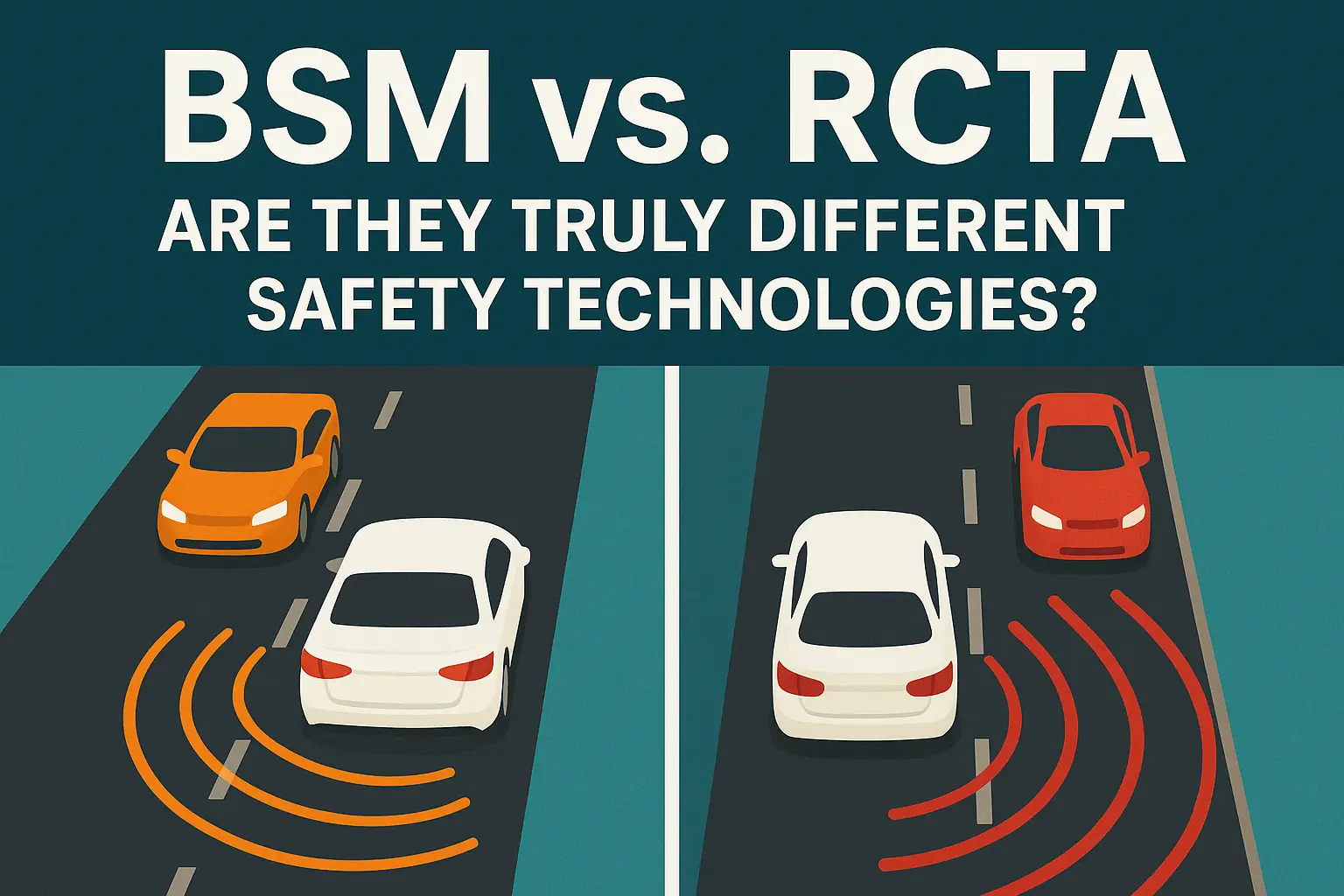
BSM and RCTA are often mentioned together, but they are not the same feature.
BSM, or Blind Spot Monitoring, helps warn the driver when another vehicle is in the side blind spot during forward driving or lane changes.
RCTA, or Rear Cross Traffic Alert, helps warn the driver when traffic is approaching from the left or right while reversing.
In many vehicles, BSM and RCTA may use similar rear radar sensors. However, they work in different driving situations, monitor different danger zones, and are designed to reduce different types of collision risks.
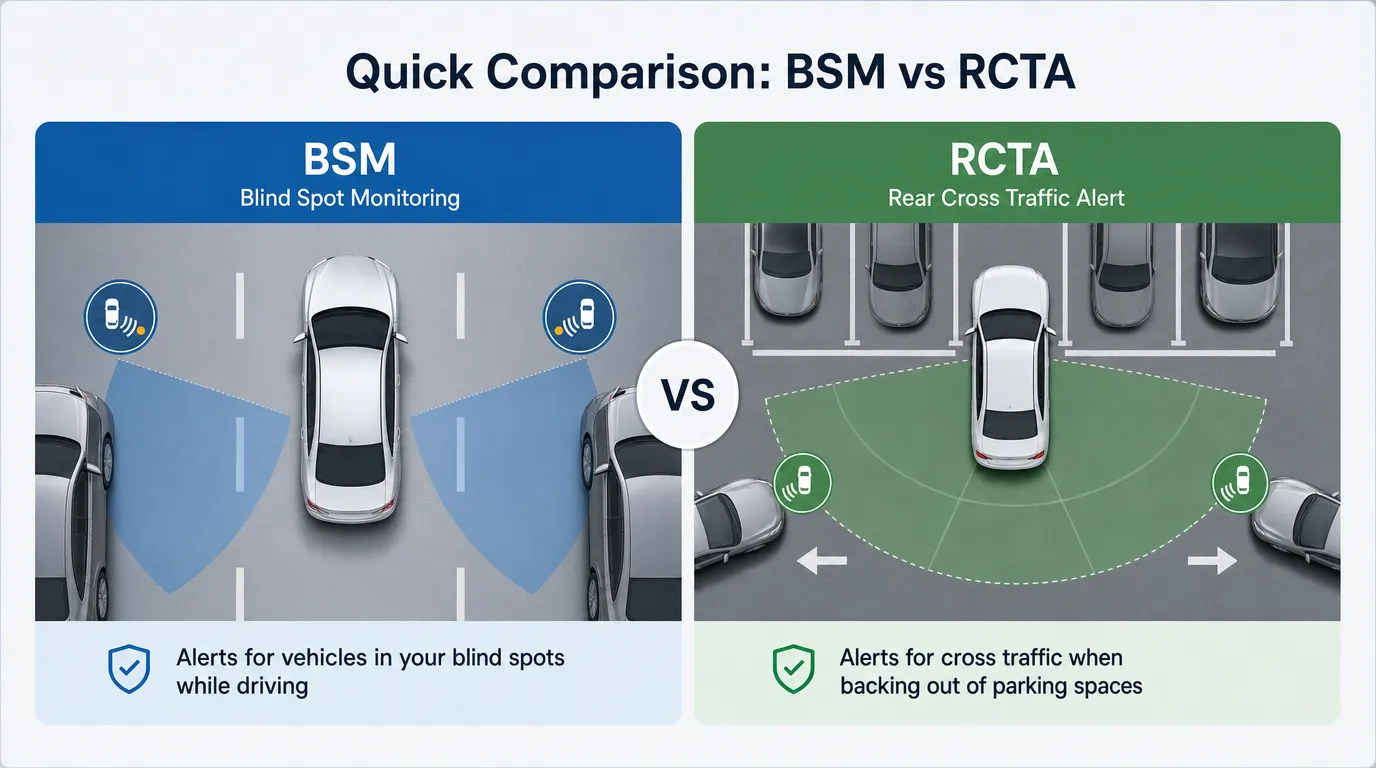
BSM vs RCTA: Quick Comparison
| Feature | BSM | RCTA |
|---|---|---|
| Full name | Blind Spot Monitoring | Rear Cross Traffic Alert |
| Main use | Side blind spot warning | Rear crossing traffic warning |
| Active when | Driving forward or changing lanes | Reversing |
| Detection area | Side and rear blind spots | Left and right rear crossing area |
| Typical alert | Mirror light, dashboard warning, buzzer | Screen warning, direction alert, buzzer |
| Main purpose | Reduce lane-change and side-swipe risks | Reduce backing collision risks |
| Common sensor type | Radar, camera, or ultrasonic sensor | Radar, camera, or ultrasonic sensor |
| Best scenario | Highway driving, lane changes, urban traffic | Parking lots, driveways, loading areas |
What Is BSM?
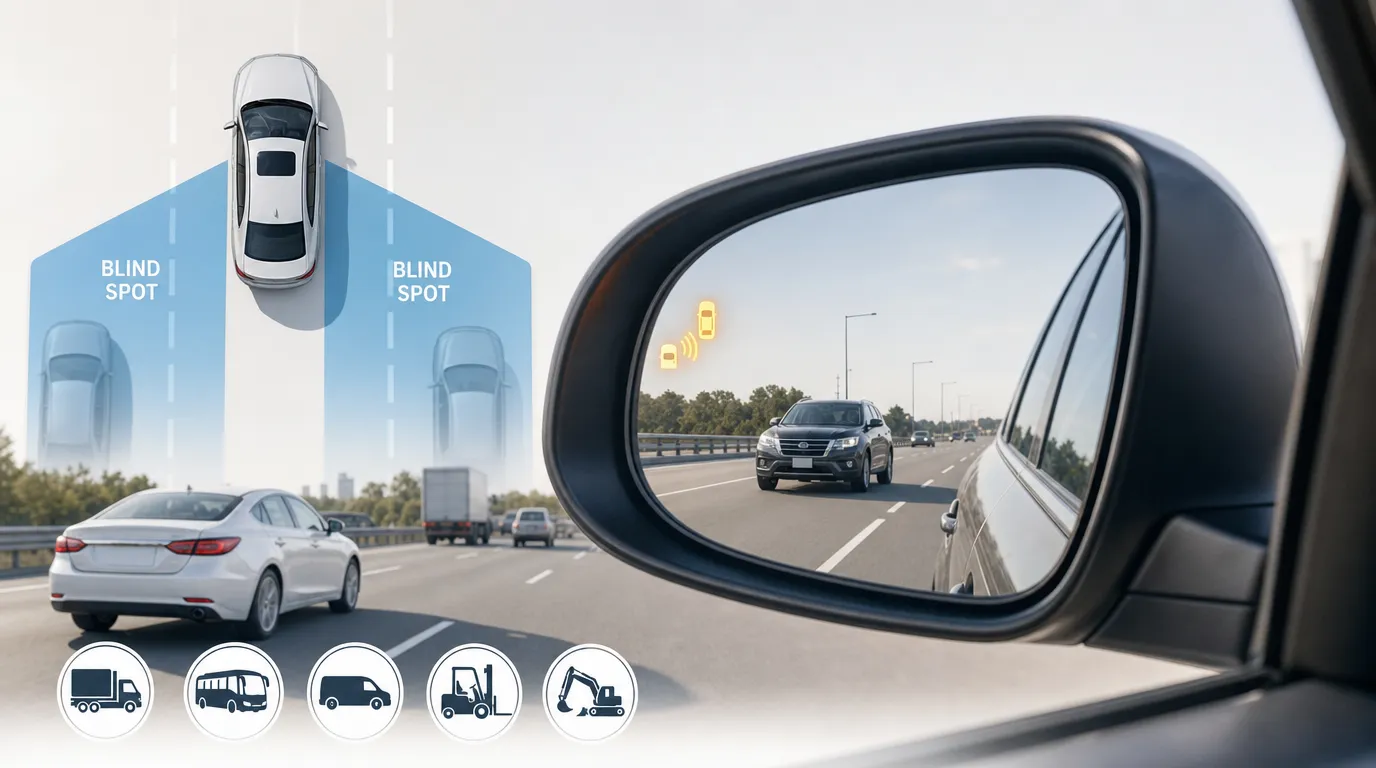
BSM stands for Blind Spot Monitoring.
It is designed to help drivers notice vehicles that are difficult to see in the side mirrors. These hidden areas are usually located beside and slightly behind the vehicle.
When another vehicle enters the blind spot zone, the system gives a warning. In many passenger cars, this warning appears as a light on the side mirror. Some systems also provide an audible alert if the driver turns on the indicator while another vehicle is still in the blind spot.
For daily driving, BSM is especially useful when changing lanes, merging into traffic, or driving on busy roads.
For commercial vehicles, the need is even greater. Trucks, buses, vans, forklifts, and construction vehicles often have larger blind spots than passenger cars. A driver may not always see a vehicle, worker, cyclist, or obstacle near the side of the vehicle, especially in a busy working environment.
This is why many fleets consider a blind spot detection system for commercial vehicles instead of relying only on mirrors.
What Is RCTA?
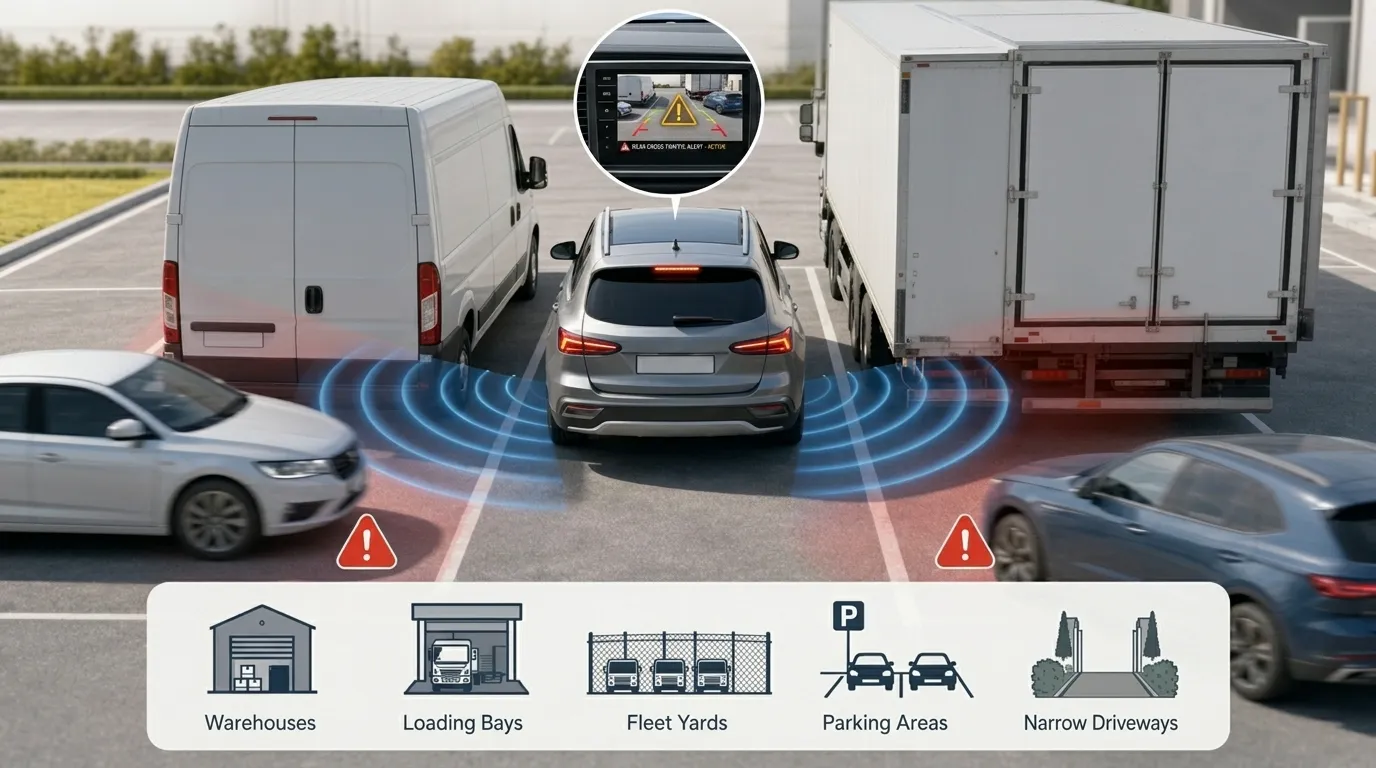
RCTA stands for Rear Cross Traffic Alert.
Unlike BSM, RCTA is mainly used when the vehicle is reversing. It checks whether another vehicle or moving object is approaching from the left or right behind the vehicle.
This is helpful when the driver’s rear view is blocked.
For example, when reversing out of a parking space between two large vehicles, the driver may not see traffic coming from either side. RCTA can detect the approaching movement and warn the driver before the vehicle continues backing out.
RCTA is also useful in places such as warehouses, loading bays, fleet yards, parking areas, and narrow driveways.
For commercial vehicles, this function can be important because reversing accidents are common in areas where visibility is limited. A rear-view camera system helps the driver see what is directly behind the vehicle, while rear cross traffic detection can help warn about movement from the sides.
Are BSM and RCTA the Same Thing?
No. BSM and RCTA are different safety functions.
They are often grouped together because some vehicles use the same rear radar sensors for both features. But the sensor is only part of the system. The real difference is how the system uses the sensor data.
BSM works while the vehicle is moving forward. It watches the side blind spot areas and nearby lanes.
RCTA works when the vehicle is in reverse. It watches for crossing traffic behind the vehicle.
So even if both functions share similar hardware, they are not simply two names for the same technology.
Key Technical Differences Between BSM and RCTA
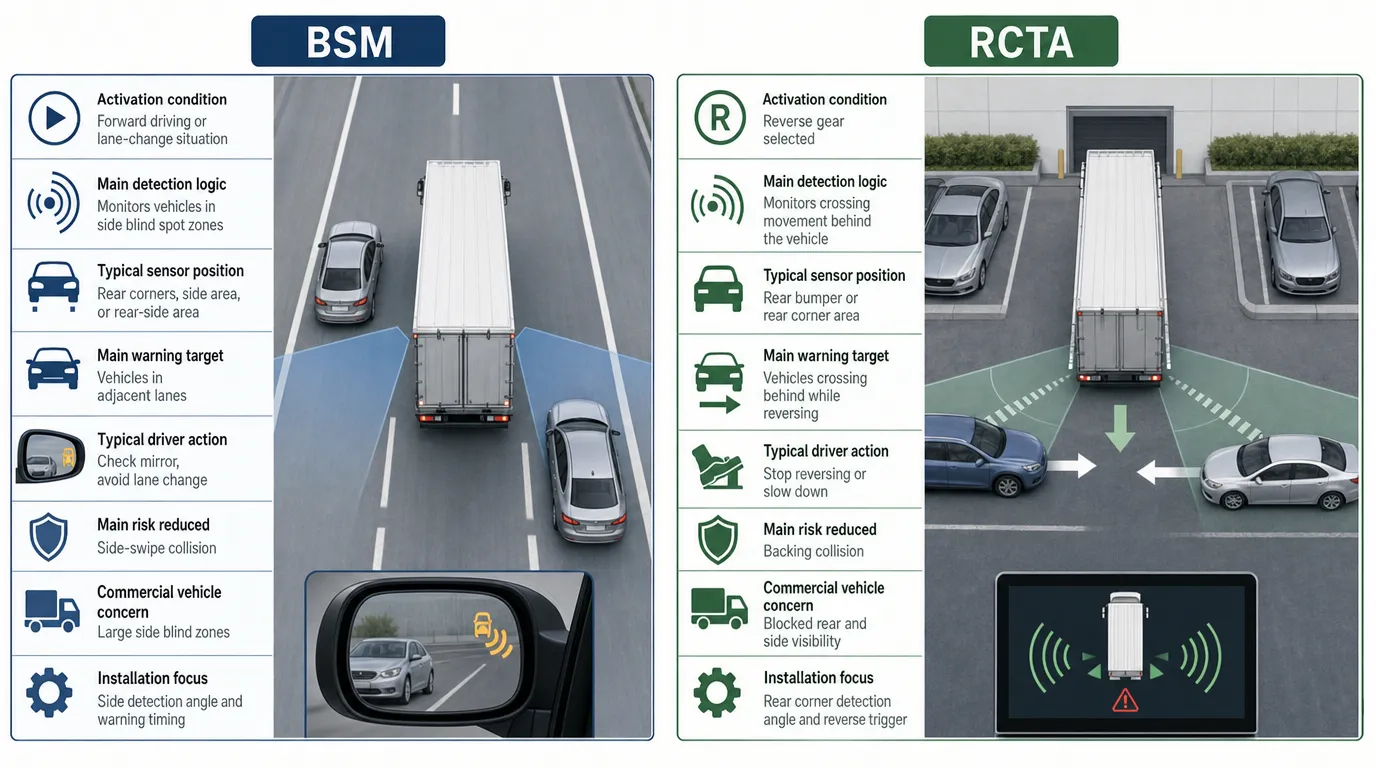
| Technical Point | BSM | RCTA |
|---|---|---|
| Activation condition | Forward driving or lane-change situation | Reverse gear selected |
| Main detection logic | Monitors vehicles in side blind spot zones | Monitors crossing movement behind the vehicle |
| Typical sensor position | Rear corners, side area, or rear-side area | Rear bumper or rear corner area |
| Main warning target | Vehicles in adjacent lanes | Vehicles crossing behind while reversing |
| Typical driver action | Check mirror, avoid lane change | Stop reversing or slow down |
| Main risk reduced | Side-swipe collision | Backing collision |
| Commercial vehicle concern | Large side blind zones | Blocked rear and side visibility |
| Installation focus | Side detection angle and warning timing | Rear corner detection angle and reverse trigger |
How Does BSM Work?
A BSM system monitors the areas beside and slightly behind the vehicle.
Depending on the system design, it may use radar sensors, cameras, ultrasonic sensors, or a combination of different detection technologies.
When a vehicle enters the monitored blind spot area, the system sends a warning to the driver. The warning may be visual, audible, or both.
In many systems, the first alert is gentle, such as a steady light on the side mirror. If the driver turns on the indicator toward the detected vehicle, the warning may become stronger.
The purpose of BSM is not to replace mirrors or safe driving habits. It gives the driver another layer of awareness, especially in situations where the blind spot is difficult to judge.
For commercial vehicles, BSM can be useful in situations such as:
- Trucks changing lanes on highways
- Buses pulling away from stops
- Vans driving in city traffic
- Construction vehicles operating near workers
- Forklifts moving near pedestrians or other equipment
How Does RCTA Work?
RCTA usually activates when the vehicle is shifted into reverse.
Instead of watching the side blind spots during forward driving, it checks whether something is moving across the rear of the vehicle from the left or right.
When the system detects a possible crossing risk, it warns the driver. The warning may appear on the rear camera screen, dashboard, side mirror, or through a buzzer.
In real use, RCTA is most helpful when the driver cannot see far enough to the left or right while reversing.
Common situations include:
- Reversing out of a parking space
- Backing out of a driveway
- Reversing near loading docks
- Moving backward in a warehouse aisle
- Backing up a van or truck with limited rear visibility
- Reversing when cargo, walls, or parked vehicles block the view
For passenger cars, RCTA is often used in parking lots. For commercial vehicles, the same idea can be applied to fleet yards, warehouses, logistics centers, construction sites, and industrial areas.
Do BSM and RCTA Use the Same Sensors?
In many vehicles, yes.
BSM and RCTA may use the same rear radar sensors installed near the rear bumper or rear corners. When the vehicle is moving forward, the system uses the sensor data for blind spot monitoring. When the vehicle is reversing, the system uses the data for rear cross traffic detection.
However, this does not mean the two functions are identical.
The detection zone, warning timing, and software logic are different.
BSM focuses on vehicles beside or slightly behind the vehicle during forward driving. RCTA focuses on crossing movement behind the vehicle during reversing.
For commercial vehicles, sensor sharing is not always enough. Vehicle size, installation height, body shape, detection angle, cable routing, power supply, waterproof rating, vibration resistance, and warning method all need to be checked before choosing a system.
Which Is More Important: BSM or RCTA?
There is no single answer. It depends on how the vehicle is used.
BSM is more important when the main risk happens during lane changes or side movement. This is common for trucks, buses, vans, and long vehicles operating on public roads.
RCTA is more important when the main risk happens during reversing. This is common in warehouses, loading bays, parking lots, construction sites, and fleet yards.
For many vehicles, both functions are useful.
If a vehicle spends most of its time on highways, a blind spot monitoring system may be the priority.
If a vehicle often reverses in tight areas, a rear-view camera, radardetectiesysteem, or rear cross traffic detection system may be more practical.
If the vehicle works near pedestrians, forklifts, workers, or other machines, an AI camera or radar detection system may provide better support than a standard passenger-car-style BSM or RCTA feature.
BSM and RCTA for Commercial Vehicles
For passenger cars, BSM and RCTA are usually built into the original vehicle design.
For commercial vehicles, the situation is different.
Many trucks, forklifts, buses, vans, construction machines, and industrial vehicles need aftermarket safety systems because the original vehicle may not include enough detection coverage.
Commercial vehicles often have:
- Larger blind spots
- Longer vehicle bodies
- Higher installation positions
- More complex reversing conditions
- More vibration and shock
- More dust, rain, mud, and outdoor exposure
- More interaction with pedestrians, workers, and equipment
This means a system should not be selected only by the function name.
A product called “BSM” or “RCTA” may work well on a passenger car, but it may not be suitable for a forklift, truck, excavator, crane, or warehouse vehicle.
For commercial use, it is more important to check the actual detection range, detection angle, target type, alert method, installation position, waterproof rating, and real-world test performance.
Why Commercial Vehicles May Need More Than Standard BSM or RCTA
Standard BSM and RCTA are helpful, but commercial vehicles often need a more flexible safety solution.
For example, a truck may need side blind spot detection when changing lanes, but it may also need a rear-view camera when reversing. A forklift may need an AI pedestrian detection camera in front of or behind the vehicle. A construction vehicle may need a rugged camera system that can handle vibration, dust, mud, and outdoor use.
In these cases, the better solution may be a combination of different systems, such as:
- Side-view camera system
- Rear-view camera system
- Radar detection system
- AI pedestrian detection camera
- Audible buzzer alarm
- LED warning light
- Multi-camera monitor system
The goal is not simply to add more devices. The real goal is to match the safety system with the vehicle’s working environment.
For a fleet manager, the key question is not only “Do we need BSM or RCTA?” but also “Where are our real blind spot risks, and what type of warning will help the driver react in time?”
Common Limitations of BSM and RCTA
BSM and RCTA can improve driver awareness, but they are still driver assistance technologies.
They should not replace mirrors, cameras, direct visual checks, or safe driving habits.
Here are some common limitations to consider.
Sensors Can Be Blocked
Mud, snow, dust, water, stickers, metal accessories, or bumper modifications may affect detection performance.
This is especially important for commercial vehicles that operate outdoors, in wet conditions, or in dusty working environments.
Small Objects May Not Always Be Detected
Some systems are mainly designed to detect vehicles. Pedestrians, bicycles, motorcycles, shopping carts, cones, pallets, or small objects may not always be detected reliably.
If pedestrian safety is the main concern, an AI pedestrian detection camera may be a better option.
Detection Range Can Vary
The actual detection distance may change depending on vehicle speed, object speed, installation angle, weather, surrounding obstacles, and sensor position.
This is why real-world testing is important before using the system on a fleet.
False Alerts Can Happen
In some environments, the system may detect walls, guardrails, signs, parked vehicles, or nearby objects and give unnecessary warnings.
For busy warehouses or construction sites, alert logic and detection zones should be adjusted carefully to avoid too many false alarms.
Blind Spot Areas Differ by Vehicle
A small van, box truck, bus, forklift, and construction machine all have different blind spot areas.
A system that works well on one vehicle may not provide enough coverage on another. Installation design is just as important as the product itself.
How to Choose the Right Safety System
Before choosing BSM, RCTA, radar, AI camera, or a rear-view camera system, start with the actual risk scenario.
Ask these questions first:
- Is the main risk during lane changes or reversing?
- Does the vehicle work on public roads, in warehouses, or on construction sites?
- Are the main targets vehicles, pedestrians, workers, forklifts, or obstacles?
- Does the driver need a camera image, warning light, buzzer, or all of them?
- What detection distance and angle are required?
- Where can the camera or sensor be installed?
- Will the system face rain, dust, vibration, mud, or frequent washing?
- Does the system need to work with an existing monitor or fleet safety setup?
For commercial fleets, a combined solution often works better than a single function.
For example:
- A truck may use truck camera systems with side cameras for blind spot viewing and a rear camera for reversing.
- A forklift may use AI pedestrian detection to warn the operator in busy warehouse areas.
- A construction vehicle may use radar sensors and a buzzer to warn of nearby obstacles.
- A large fleet may use multi-camera systems to improve visibility around the vehicle.
The best system is not always the most complex one. It is the one that fits the vehicle, the driver’s working habits, and the real accident risk.
BSM vs RCTA: Which One Should You Choose?
Choose BSM if your main problem is side blind spots during forward driving.
This is usually more suitable for:
- Trucks
- Buses
- Vans
- Long vehicles
- Highway fleets
- Urban delivery vehicles
Choose RCTA or a rear detection system if your main problem is reversing safety.
This is usually more suitable for:
- Parking areas
- Warehouses
- Loading docks
- Fleet yards
- Delivery vehicles
- Forklifts and industrial vehicles
Choose an AI camera or radar detection system if the vehicle works around pedestrians, workers, forklifts, or moving equipment.
In many commercial applications, the best answer is not BSM or RCTA alone. It may be a customized safety system that combines camera visibility, detection alerts, and driver warning devices.
Conclusie
BSM and RCTA are different safety technologies.
BSM helps warn drivers about vehicles in side blind spots while driving forward or changing lanes. RCTA helps warn drivers about crossing traffic when reversing.
They may use similar sensors in some vehicles, but they work in different situations and use different detection logic.
For passenger cars, both features can improve daily driving safety. For commercial vehicles, the right solution depends on the vehicle type, blind spot area, installation environment, detection target, and warning method.
If your vehicle operates in areas with large blind spots, frequent reversing, pedestrian movement, or limited visibility, it may be worth considering a dedicated camera, radar, or AI detection system designed for commercial vehicle safety.
For commercial vehicles, the best setup should be selected according to the actual blind spot area, reversing condition, and driver warning needs. You can contact met ons opnemen to discuss a suitable camera, radar, or AI detection solution for your vehicle.
FAQ
Are BSM and RCTA the same thing?
No. BSM and RCTA are different functions. BSM monitors side blind spots during forward driving, while RCTA monitors crossing traffic behind the vehicle when reversing.
What is the main difference between BSM and RCTA?
The main difference is the driving situation. BSM is used when driving forward or changing lanes. RCTA is used when reversing.
Do BSM and RCTA use the same sensors?
In many vehicles, they may use similar or shared rear radar sensors. However, the detection zones and software logic are different.
Does RCTA detect pedestrians?
Some systems may detect pedestrians or moving objects, but many RCTA systems are mainly designed to detect vehicles crossing behind the car. If pedestrian detection is important, an AI pedestrian detection camera may be more suitable.
Which is better, BSM or RCTA?
Neither is better in every situation. BSM is better for lane-change and side blind spot risks. RCTA is better for reversing and rear crossing traffic risks.
Are BSM and RCTA useful for commercial vehicles?
Yes, but the system must be selected carefully. Commercial vehicles usually have larger blind spots and more complex working environments than passenger cars.
Can BSM or RCTA replace mirrors and cameras?
No. BSM and RCTA are driver assistance features. Drivers should still use mirrors, cameras, signals, and direct visual checks whenever possible.
What is the best blind spot solution for commercial vehicles?
The best solution depends on the vehicle and working environment. Options may include side-view cameras, rear-view cameras, radar detection systems, AI pedestrian detection cameras, warning lights, buzzers, or multi-camera monitor systems.

 Dutch
Dutch  English
  Spanish
  Japanese
  German
  Arabic