
Choosing a fleet camera system sounds simple at first. But once blind spot coverage, recording requirements, channel limits, and future expansion come into the discussion, the wrong decision can create visibility gaps, weak evidence capture, and expensive rework later.
In most commercial fleets, a 4CH camera system is enough for basic front, side, and rear visibility. An 8CH system is a better fit when larger vehicles need more camera positions or more expansion room. An MDVR system is usually the stronger choice when a fleet also needs structured recording, longer storage, event review, and better incident traceability.
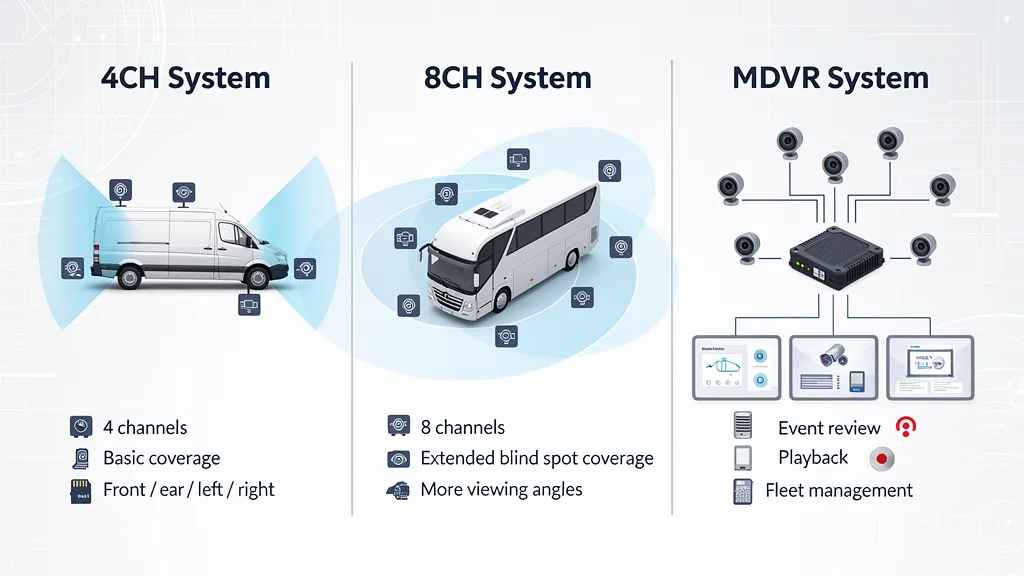
The right choice is not only about how many cameras can be connected. It is about how the fleet operates, what drivers need to see in real time, what managers need to review after an incident, and how likely the system is to expand over the next one to two years.
Quick Answer: Which Fleet Camera System Should You Choose?
A 4CH system is usually the right choice for vans, light trucks, and service vehicles that need basic front, rear, and side coverage. An 8CH system is better for larger trucks, buses, refuse vehicles, and mixed fleets that need more viewing angles or future expansion. An MDVR system is the best fit when recording reliability, evidence retention, playback, and fleet-wide video management matter as much as live visibility.
A practical way to understand the difference is this:
- 4CH = basic visibility improvement
- 8CH = broader camera coverage and more flexibility
- MDVR = coverage plus structured recording and fleet oversight
What Does a 4CH Camera System Actually Fit?
A 4CH camera system fits commercial vehicles that need up to four camera inputs, usually covering the main operational blind spots without adding unnecessary complexity. It is commonly used on delivery vans, light trucks, service vehicles, and some medium-duty commercial vehicles.
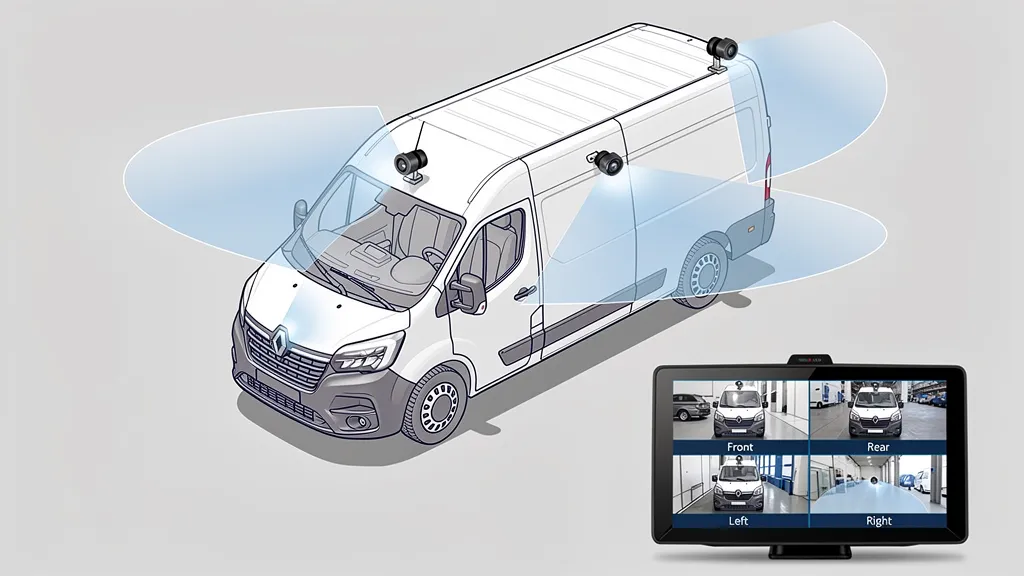
For many fleets, 4CH is the most practical starting point. A standard layout often includes one front camera, one rear camera, and one camera on each side. That setup already improves reversing, turning awareness, side observation, and daily maneuvering.
On vehicles with a straightforward task profile and predictable routes, four channels are often enough to address the main visibility risks. This is especially true for vehicles that do not require cargo-area monitoring, trailer views, driver-facing video, or extra close-range blind spot cameras.
Another reason 4CH works well is operational simplicity. Drivers usually adapt faster to a simpler display layout. Installers often face fewer routing and wiring challenges. Fleet managers can standardize more easily across similar vehicle types and reduce maintenance variation.
Still, 4CH has clear limits. Channels can run out quickly if the fleet also wants:
- cargo-area monitoring
- an additional close-side blind spot view
- driver-facing video
- trailer-related coverage
- more than one rear or side angle
That is why 4CH should not be treated as the default answer for every commercial vehicle. It is the right choice only when the actual blind spot map and operating risk match the channel capacity. For fleets still defining the real camera positions they need, a truck camera placement guide can help clarify whether four channels are truly enough.
Typical 4CH Fit by Vehicle Type
| Vehicle type | Typical 4CH fit | Why it works |
|---|---|---|
| Delivery van | Very good | Basic blind spot coverage is often enough |
| Light truck | Good | Front, rear, and both sides usually cover the main needs |
| Service vehicle | Good | Clear operating pattern and simpler installation |
| Medium-duty truck | Sometimes | Depends on route complexity and body design |
| Articulated truck | Often limited | Extra viewing angles are often needed |
When Does an 8CH Camera System Make More Sense?
An 8CH camera system makes more sense when a vehicle has more blind spots, more operational risk, or more monitoring requirements than a 4CH system can support. It is commonly used on larger trucks, buses, refuse vehicles, specialist vehicles, and mixed fleets that want better coverage and more room for future upgrades.
Larger commercial vehicles rarely operate with only one simple risk pattern. They reverse into loading bays, turn in tight streets, pass cyclists, maneuver in depots, and sometimes work in poor weather, low light, or dense urban environments. In these cases, the basic four-camera layout is often only the starting point.
Additional channels may be needed for:
- front corner coverage
- close-side blind spot views
- cargo or load-area monitoring
- driver cabin recording
- auxiliary reversing angles
- trailer or attachment views
The real advantage of 8CH is not only that it supports more cameras. It gives fleets more planning room. A system that looks sufficient at the start may become restrictive later if vehicle risk, route profile, or operating requirements change.
An 8CH platform can also support better standardization across mixed fleets. Even if some vehicles use only five or six channels at first, choosing the same recorder family and connector logic across multiple vehicle types can simplify training, spare parts, maintenance, and future rollout planning. This becomes even more important when fleets need to compare installation architecture across vehicle platforms, which is where a multi-camera wiring and connector guide becomes useful.
4CH vs 8CH at a Glance
| Need | 4CH | 8CH |
|---|---|---|
| Basic front/side/rear coverage | Good fit | Also works, but may be more than needed |
| Larger vehicle blind spot coverage | Limited | Better fit |
| Future expansion | Limited | Stronger |
| Mixed vehicle fleet standardization | Moderate | Better |
| Multi-angle recording strategy | Limited | Stronger |
What Makes an MDVR System Different from a Standard Multi-Camera Setup?
An MDVR system is more than a monitor with recording. It is a mobile digital video recorder designed for continuous multi-channel recording, storage management, event retrieval, and fleet-focused video evidence handling.
This difference matters because seeing and recording are not the same thing. A standard monitor-based camera system may help the driver in real time, but an MDVR system also helps the fleet retain, retrieve, and manage video after an incident.
That makes MDVR more relevant in fleets where disputes, insurance claims, driver coaching, safety events, and internal reviews are part of daily operations. In these fleets, the value of the system is not limited to live viewing. It also affects post-incident evidence quality, review efficiency, and long-term accountability.
A simple monitor-based recording function may be enough for some applications. But if a fleet needs stronger traceability, longer footage retention, more organized playback, or possible integration with GPS or fleet management workflows, MDVR is usually the stronger long-term platform. For fleets that also need to justify the investment in operational terms, a clear fleet camera system ROI assessment can help connect video capability with claims reduction, downtime control, and incident management.
When MDVR Is Usually the Better Choice
MDVR is often the better choice when the fleet needs:
- reliable multi-camera recording
- longer footage retention
- structured incident review
- stronger video evidence after accidents or disputes
- a more scalable video management approach across multiple vehicles
MDVR is not always the cheapest or simplest path. It usually involves more installation planning, storage policy decisions, and system management. But for fleets that care about both live visibility and post-incident evidence, that added structure is often exactly the value.
4CH vs 8CH vs MDVR: Core Difference
| System type | Main strength | Best fit |
|---|---|---|
| 4CH monitor system | Simplicity | Basic visibility improvement |
| 8CH monitor system | More camera coverage | Larger vehicles and additional angles |
| MDVR system | Recording and fleet oversight | Fleets needing evidence, retrieval, and management |
How Should Fleets Choose Between 4CH, 8CH, and MDVR?
The best way to choose between 4CH, 8CH, and MDVR is to start with vehicle risk, required camera positions, recording expectations, and future rollout plans. The right answer depends less on the product label and more on how the vehicle and fleet actually operate.
A practical fleet selection process usually starts with five questions.
1. What does the driver need to see in real time?
This defines the minimum camera coverage required for daily operation. Fleets should map actual blind spots, not assumed ones.
2. What does the fleet need to record and keep?
Some fleets only need live viewing and short basic recording. Others need evidence retention, event review, and a more structured playback process.
3. How many camera positions are truly necessary?
The answer should come from operating risk, vehicle body shape, and maneuvering conditions, not from a brochure checklist.
4. Will the same platform be used across different vehicle types?
Mixed fleets often benefit from choosing a system with more headroom so standardization remains possible as the rollout expands.
5. What is likely to change in the next one to two years?
Many fleets under-specify the first installation because they buy only for today’s needs. New vehicle types, new safety policies, and extra review requirements often appear later.
Common Selection Scenarios
Choose 4CH when:
- the vehicle layout is simple
- the main goal is basic blind spot reduction
- installation simplicity matters
- the fleet does not expect major expansion soon
Choose 8CH when:
- the vehicle has multiple blind spot zones
- more than four camera positions may be needed
- the fleet wants room for future expansion
- mixed vehicle standardization is a priority
Choose MDVR when:
- video evidence matters after incidents
- longer recording retention is required
- multiple camera channels must be reviewed in a structured way
- fleet managers need more oversight than a monitor-only system can provide
Decision Matrix: 4CH vs 8CH vs MDVR
| Decision factor | 4CH | 8CH | MDVR |
|---|---|---|---|
| Simple vehicle layout | Strong | Good | Possible but may be too much |
| Many blind spots | Limited | Strong | Strong |
| Incident evidence needs | Basic | Moderate | Strong |
| Expansion flexibility | Limited | Strong | Strong |
| Fleet management visibility | Basic | Moderate | Strong |
| Installation simplicity | Strong | Moderate | Lower |
Common Buying Mistakes Fleets Should Avoid
The most common mistake is choosing only by initial price. A lower-cost system can become more expensive later if it cannot support the real number of cameras, the required recording workflow, or future expansion.
Other common mistakes include:
- underestimating how many viewing angles the vehicle really needs
- ignoring post-incident video retrieval requirements
- choosing different system types across the fleet without a standardization plan
- overlooking connector compatibility, storage handling, and maintenance support
- buying for today’s layout without considering likely changes in the next rollout phase
In practice, fleets do not only buy camera channels. They buy a long-term safety and operational tool. That is why channel count, recording structure, serviceability, and future compatibility should all be reviewed together.
Conclusie
The best fleet camera system is the one that matches real vehicle risk, daily operating conditions, recording expectations, and future rollout plans.
A 4CH system is often the right fit for straightforward commercial vehicles that need basic front, rear, and side coverage. An 8CH system is the better choice when vehicles need broader multi-angle visibility or future expansion. An MDVR system is the strongest option when the fleet also needs reliable recording, evidence retention, and structured incident review.
A good selection process starts with a vehicle-by-vehicle risk map, a camera coverage plan, and a clear recording policy. That approach helps fleets avoid under-specifying, over-specifying, and paying twice for the same installation.
FAQ
Is a 4CH camera system enough for a commercial truck?
A 4CH camera system is enough for some commercial trucks if the vehicle only needs basic front, rear, and side coverage. It is usually a good fit for vans, light trucks, and service vehicles, but larger trucks often need more than four camera positions.
When should a fleet choose an 8CH camera system?
A fleet should choose an 8CH camera system when the vehicle has multiple blind spot zones, more complex operating conditions, or likely future expansion. It is often a better fit for larger trucks, buses, refuse vehicles, and mixed fleets.
What is the difference between an MDVR system and a standard monitor with recording?
An MDVR system is designed for structured multi-channel recording, storage management, event retrieval, and fleet video oversight. A standard monitor with recording may support basic footage capture, but MDVR is usually much better for incident review and evidence retention.
Is MDVR always better than a 4CH or 8CH system?
MDVR is not always better. It is better when the fleet needs stronger recording, longer retention, and more structured review. For simpler vehicles with basic visibility goals, a 4CH or 8CH system may be more practical and cost-effective.
How do fleets choose the right number of camera channels?
Fleets should choose the number of camera channels based on actual blind spots, operating risk, recording goals, and future expansion needs. The right choice depends on vehicle layout and fleet use, not only on price.

 Dutch
Dutch  English
  Spanish
  Japanese
  German
  Arabic