
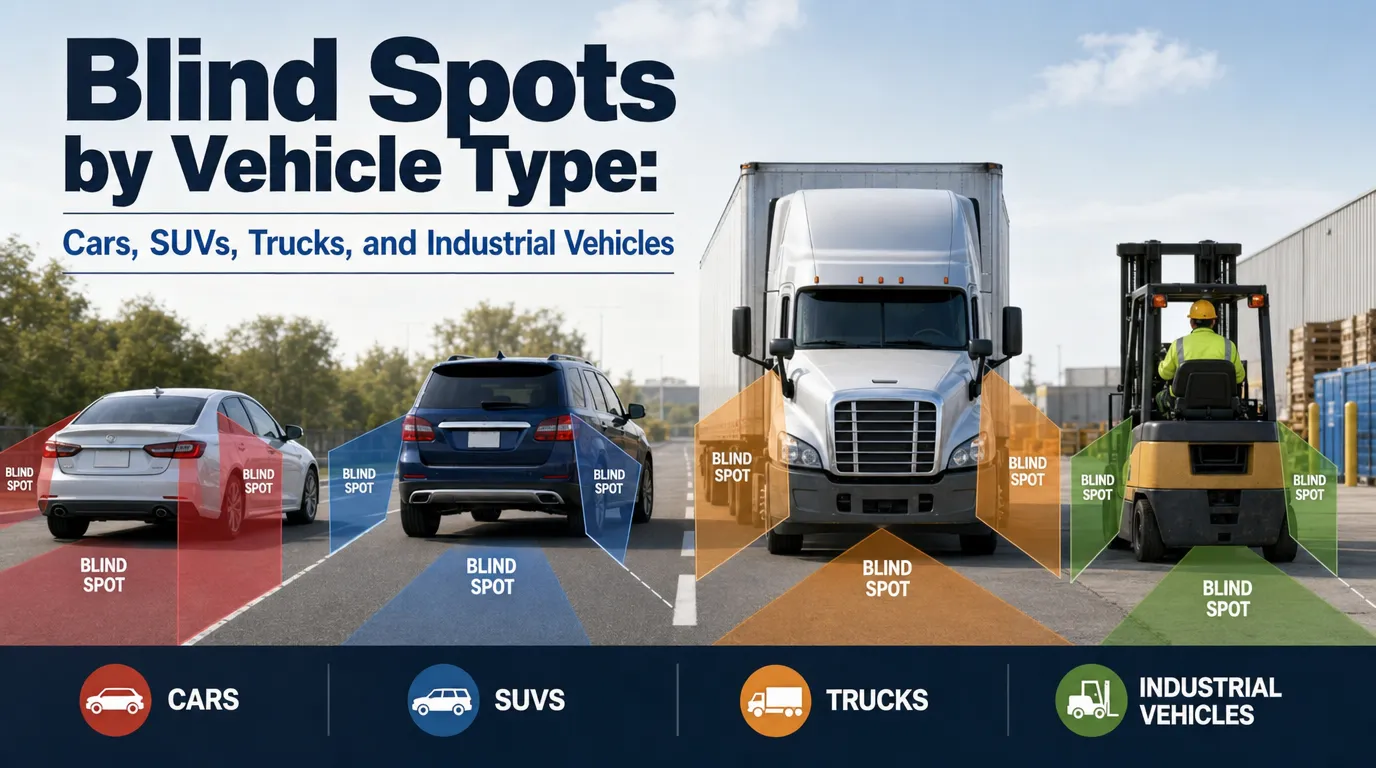
Many drivers assume blind spots are basically the same on every vehicle. That mistake can lead to the wrong detection system, poor installation choices, and avoidable safety risks.
Blind spots differ by vehicle type because each vehicle has a different body shape, seating position, mirror coverage, operating environment, and visibility limit. Cars often have lane-change blind spots. SUVs add near-body visibility problems. Trucks have larger side, front, and rear blind zones. Industrial vehicles can have changing work-zone blind spots caused by loads, attachments, and site conditions.
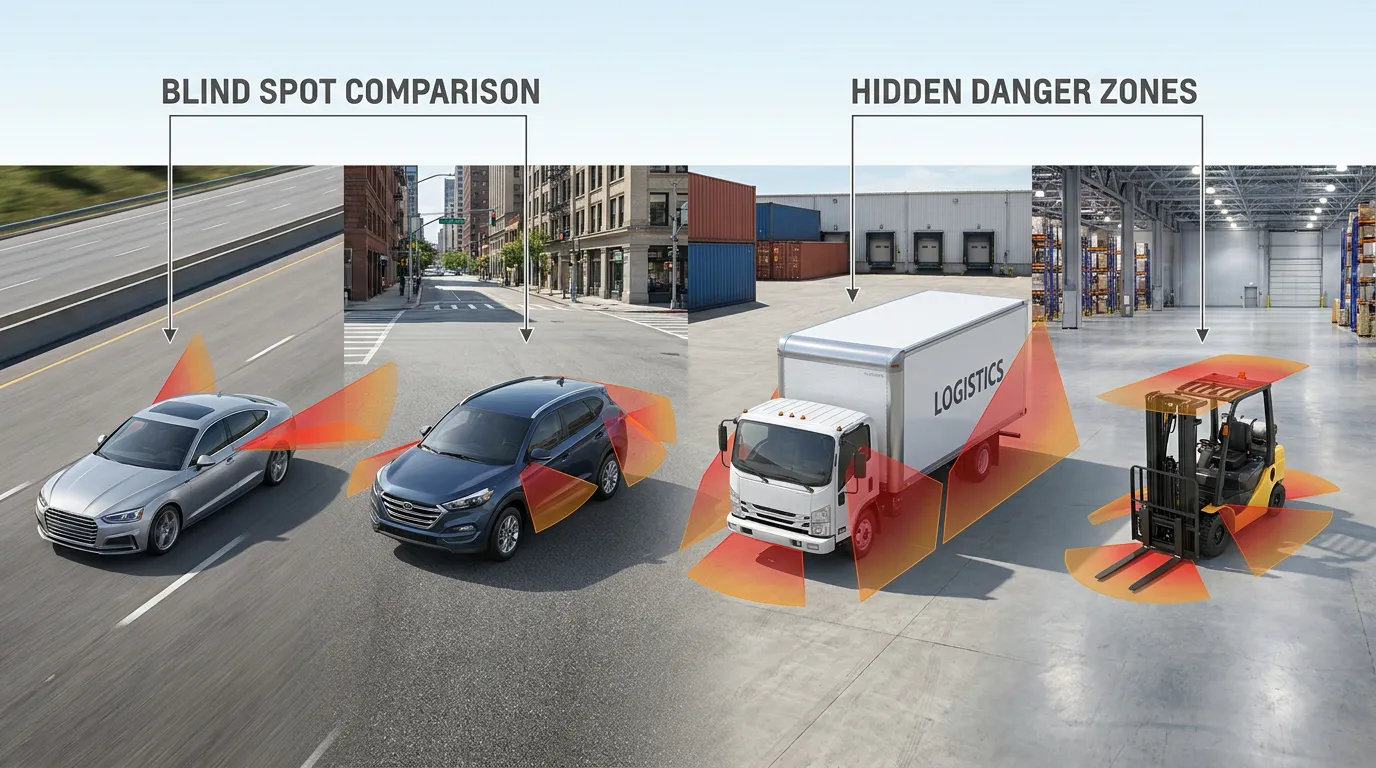
A blind spot is never just a blind spot. It belongs to a specific vehicle, a specific driving task, and a specific risk area. That is why applying the same safety logic to a passenger car, SUV, commercial truck, and forklift often leads to poor results. These vehicles do not create risk in the same way. Their blind spots are shaped by different body dimensions, driver positions, mirror coverage, work tasks, and operating conditions.
Once the vehicle types are separated clearly, it becomes much easier to choose the right camera, sensor, monitor, warning system, or combined blind spot detection solution.
Quick Answer: How Do Blind Spots Differ by Vehicle Type?
Blind spots differ by vehicle type because each vehicle creates different hidden zones and different accident risks. A passenger car usually has side rear quarter blind spots during lane changes. An SUV often adds near-body and rear visibility problems. A truck has larger side, near-front, and rear blind zones. An industrial vehicle may have dynamic blind spots that change with the load, attachment, or working environment.
A practical way to think about it is:
- cars usually need lane-change and rear-quarter awareness
- SUVs need side, rear, front-corner, and near-body visibility support
- trucks need side turning, near-front, rear, and cab-adjacent blind spot coverage
- industrial vehicles need short-range work-zone visibility and worker detection support
Why Do Blind Spots Change So Much Between Vehicle Types?
Blind spots change between vehicle types because body height, body length, window size, pillar thickness, seat position, mirror layout, cargo structure, attachments, and operating conditions all affect what the driver can and cannot see. The larger or more specialized the vehicle becomes, the more complex the blind spot pattern usually gets.
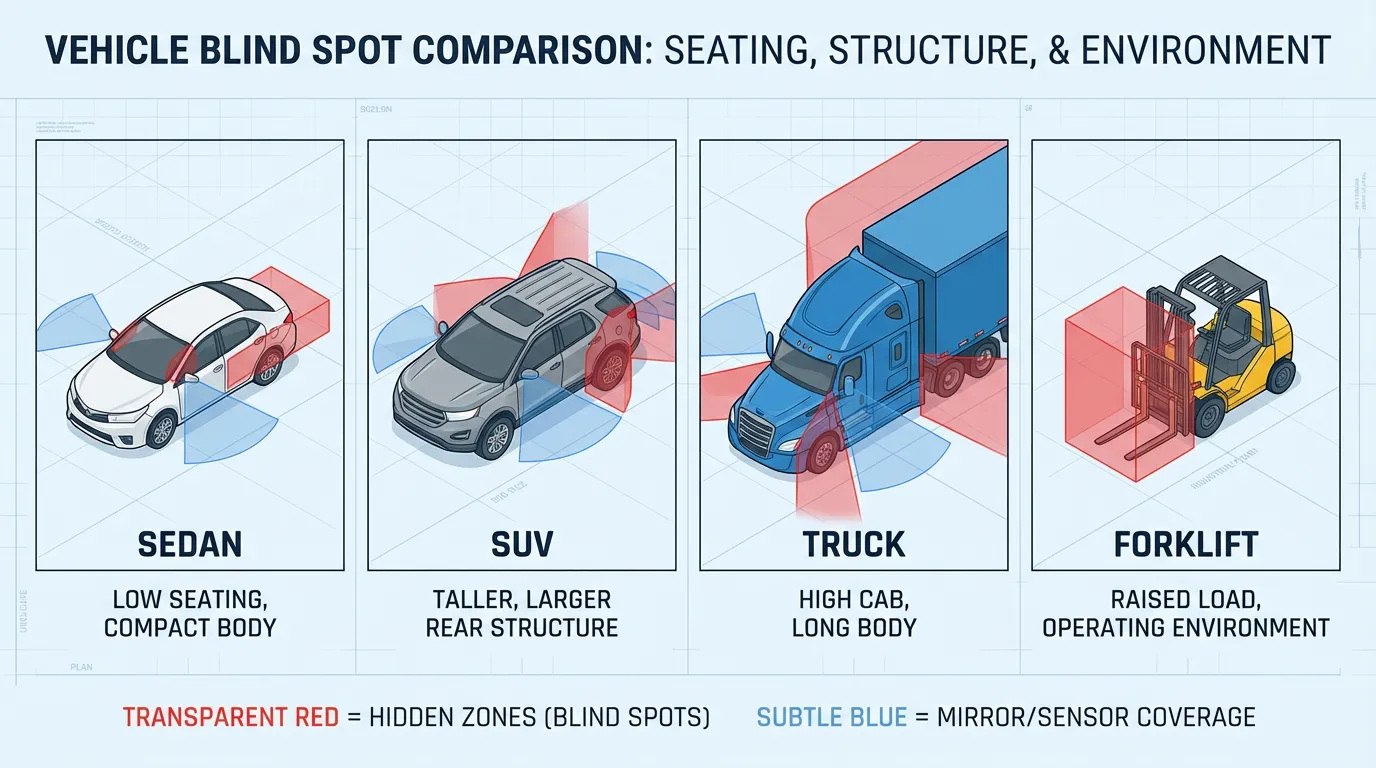
The simplest way to understand this is to compare what the driver sees from the seat. In a passenger car, the driver sits relatively low, with a clear forward view and a shorter body that is easier to judge. Blind spots still exist, but they are often concentrated around the side rear quarter and adjacent lane area.
In an SUV, the higher body and larger proportions change that picture. The driver gains a higher road view, but may lose natural awareness of the lower near-body area, front corners, and rear zones.
In a truck, the difference becomes much larger. The driver sits high above the road, and the vehicle body becomes longer, wider, and more difficult to monitor through direct vision and mirrors alone. Side blind spots become more serious. Near-front areas also matter more. Rear visibility depends heavily on the body design and camera or mirror setup.
Industrial vehicles change the picture again. A forklift, loader, yard tractor, or plant vehicle may work in tight spaces around racks, pallets, workers, machines, and changing loads. In those cases, the blind spot is not only created by the vehicle body. It is also created by the task, the load, and the work area.
| Vehicle factor | Why it changes blind spots |
|---|---|
| Seating height | Changes near-field visibility and distance judgment |
| Body size | Increases hidden zones around the vehicle |
| Window and pillar design | Affects direct driver view |
| Mirror coverage | Expands or limits indirect vision |
| Cargo or attachment layout | Can block important working areas |
| Operating environment | Changes which blind spots are most dangerous |
What Blind Spots Are Most Common in Passenger Cars?
The most common blind spots in passenger cars are the side rear quarter zones, adjacent lane areas during lane changes, and smaller near-corner areas around the body. These blind spots are usually smaller than those on commercial vehicles, but they still matter because they affect everyday traffic decisions.
Passenger cars can feel easy to manage because they are smaller than trucks and buses. Still, many incidents happen in exactly the areas drivers think they have already checked.
The most familiar passenger car blind spot is the lane-change zone. Side mirrors help, but they do not show everything. A vehicle, motorcycle, or cyclist can remain beside and slightly behind the car, especially during quick lane changes or heavy traffic. That is why blind spot monitoring systems became so popular in the passenger car market.
Passenger cars can also have smaller visibility gaps near the front corners and around the rear body. These are usually less dramatic than the blind zones on trucks or industrial vehicles, but they can still affect parking, reversing, and tight-space movement.
Car blind spot solutions often focus on fast awareness and convenience. The system may use a radar warning in the mirror, a camera-based side view, or a combined alert system. The key point is that the hidden area is usually related to ordinary road traffic rather than large work-zone hazards.
| Passenger car blind spot area | Why it matters |
|---|---|
| Side rear quarter | Main lane-change conflict zone |
| Adjacent lane | Risk from vehicles or motorcycles not seen in mirrors |
| Rear body corner | Can affect reversing and parking awareness |
| Front corner area | Can reduce awareness in tight spaces |
How Are SUV Blind Spots Different from Car Blind Spots?
SUV blind spots are different from car blind spots because SUVs usually have a taller body, higher beltline, thicker rear structure, and larger body volume. This can create stronger side blind spots, reduced near-body visibility, and weaker awareness of front corners and the rear area.
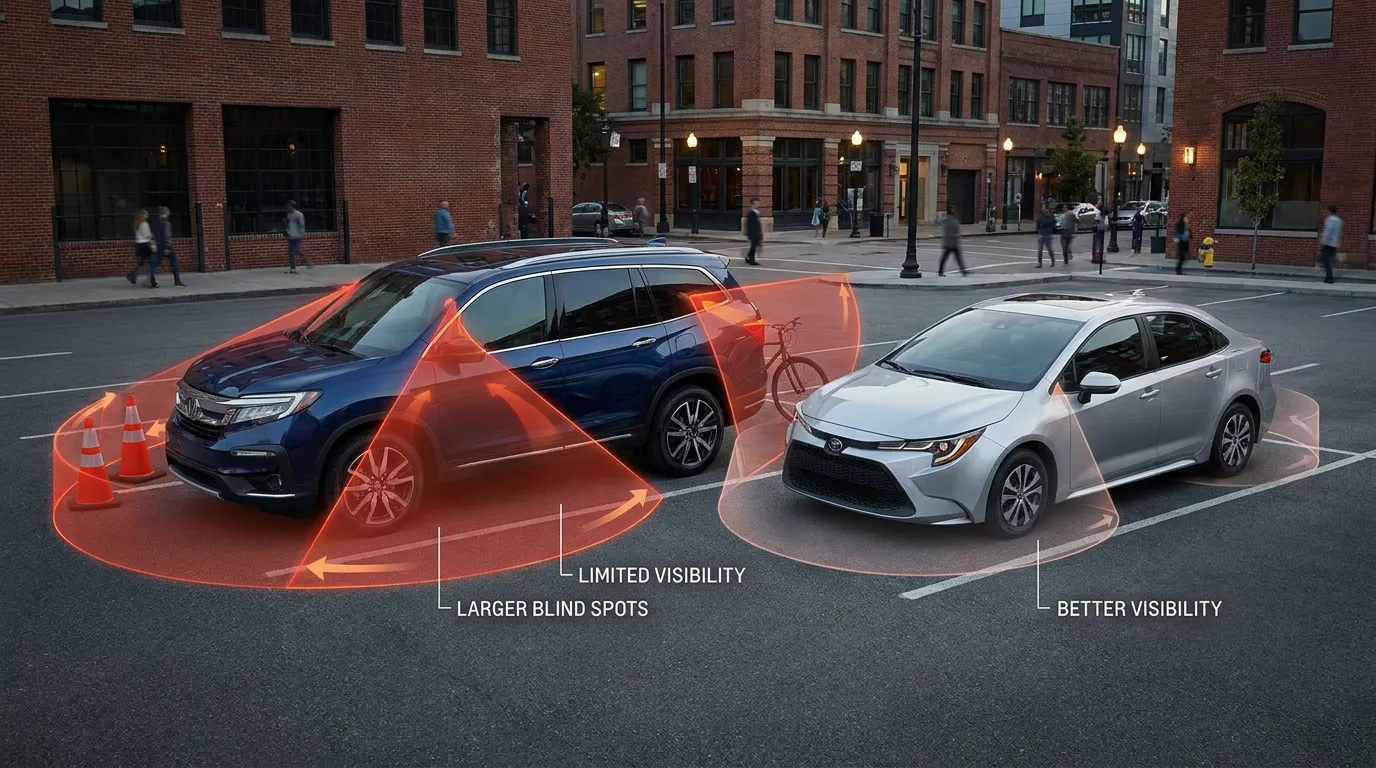
SUVs are often seen as easier to drive because of their higher seating position. That is only part of the story. The added height can improve the general road view, but it does not automatically solve what happens close to the vehicle. In some situations, the larger body can make close-range visibility more difficult.
The front corners may feel harder to judge. The side area can still hide smaller vehicles, cyclists, or pedestrians. The rear body may create more uncertainty during reversing. This is why SUV blind spot problems often combine passenger-car lane-change risks with larger-vehicle near-body risks.
A system that works well for a low passenger car may not feel complete on a larger SUV, especially when the driver wants more support during urban driving, parking, reversing, or family-use situations.
For SUVs, blind spot detection is not only about safety in lane changes. It can also improve driver confidence in tight spaces, around pedestrians, and during low-speed maneuvering.
| SUV blind spot area | Why it matters |
|---|---|
| Side rear quarter | Important during lane changes |
| Near-body side area | Harder to judge because of height and body size |
| Front corners | Less natural visibility in tight spaces |
| Rear area | Larger body makes reversing less intuitive |
Why Are Truck Blind Spots More Dangerous and More Complex?
Truck blind spots are more dangerous and more complex because trucks are larger, sit higher, turn differently, and operate around vulnerable road users and other vehicles with less direct visibility. Key truck blind spots often include the side turning zone, near-front area, cab-adjacent side area, and rear maneuvering area.
A truck does not only have bigger blind spots. It also creates bigger consequences when those blind spots are not controlled well. That is why truck visibility requires a different level of planning.
Truck blind spots should be understood as multiple risk zones rather than one mirror gap. A truck may have a critical side blind area where cyclists, pedestrians, or smaller vehicles can disappear during turning. It may also have a near-front area that is difficult to judge from the high cab position, especially in stop-and-go traffic, depots, or urban delivery routes.
At the rear, the body style changes everything. A box truck, tanker, flatbed, trailer, or refuse vehicle will not create the same reversing visibility problem. That means camera placement and detection logic should be matched to the truck body and operating task.
Truck blind spot safety often goes beyond one simple warning sensor. It becomes a system question that may involve camera placement, monitor layout, side detection, AI detection, recording, connector durability, and compliance-related thinking. For fleets planning camera positions, a dedicated truck camera placement guide can help match front, side, and rear cameras to the real risk zones.
| Truck blind spot area | Main risk |
|---|---|
| Side turning zone | Cyclists, pedestrians, and smaller vehicles during turns |
| Near-front area | Close road users hidden by cab height |
| Rear area | Reversing, docking, and rear maneuvering risk |
| Cab-adjacent side area | Vulnerable road users close to the vehicle |
How Do Industrial Vehicle Blind Spots Create Different Safety Problems?
Industrial vehicle blind spots create different safety problems because industrial vehicles often operate in tight work zones around pedestrians, racks, pallets, machinery, and changing loads. Their blind spots may shift with the task, attachment, or carried load, which makes camera support and detection logic especially important.
Industrial vehicles may move more slowly than road vehicles, but that does not make the blind spot problem smaller. In many workplaces, the risk is more immediate because people, pallets, racks, and machines are close to the vehicle.
Industrial blind spots are different because the work area itself becomes part of the visibility problem. A forklift may lose forward visibility because of the load, not only because of the mast. A yard vehicle may have restricted rear and side visibility because of body shape and working layout. A loader or site machine may create wide side and rear danger zones during turning or reversing.
Another key difference is that industrial vehicles often work near people on foot. In a warehouse, factory, yard, or site, the danger zone is often close to the vehicle. That means the driver may need strong short-range visibility more than long-range traffic awareness.
Camera systems, wireless safety cameras, AI pedestrian detection, and warning alarms can all play a bigger role here than on a standard passenger car. This is why road-car blind spot logic should not be applied directly to industrial equipment.
| Industrial vehicle blind spot area | Typical risk |
|---|---|
| Forward working zone | Load or mast blocks direct view |
| Side work area | Workers or objects near turning path |
| Rear area | Reversing in tight spaces |
| Load-related zone | Blind area changes with cargo or attachment |
How Should Detection Technology Change by Vehicle Type?
Detection technology should change by vehicle type because different vehicles need different combinations of visibility support, object detection, warning logic, recording, and durability. Cars often suit basic blind spot monitoring alerts. SUVs may benefit from added camera support. Trucks often need multi-camera and alert systems. Industrial vehicles may need short-range visibility and worker detection.
A safety system that works well on one vehicle may be incomplete, excessive, or badly matched on another. The technology should follow the blind spot pattern, not the other way around.
For passenger cars, a radar-based blind spot monitoring system may solve the main everyday lane-change problem. For SUVs, stronger value may come from combining alerts with better visual support because the body size creates more near-vehicle uncertainty.
For trucks, the solution often becomes more system-based. A side warning sensor alone may not be enough. The driver may need side cameras, rear cameras, front close-range awareness, alarms, and recording support together.
Industrial vehicles change the priority again. In these applications, the first concern is often close-range safety and work-zone awareness. If a worker, pallet, rack, or machine can enter the danger area quickly, the system has to support that exact risk. A wireless rear camera, AI pedestrian alert, side detection alarm, or rugged monitor may be more useful than a standard passenger-car blind spot module.
If you are comparing detection technologies, a separate camera vs radar for blind spot detection guide can help clarify when visibility, warning, or a combined solution makes more sense.
| Vehicle type | Better-fit detection approach |
|---|---|
| Car | Basic blind spot monitoring or side alert system |
| SUV | Blind spot alert plus stronger visual support |
| Truck | Multi-camera system, side alerts, recording, and wider coverage |
| Industrial vehicle | Short-range camera support, worker detection, and work-zone alerts |
What Should Buyers Check Before Choosing a Blind Spot System?
Before choosing a blind spot system, buyers should check vehicle type, blind spot location, operating environment, installation space, power supply, driver interface, durability needs, and whether the system is meant to show the area, detect the area, or do both.
A blind spot system can sound perfect in a brochure and still fail in practice if it does not match the vehicle, environment, or installation limits. Good selection starts with the real risk, not the feature list.
Start with five simple questions:
- What exact blind area needs to be covered?
- What vehicle type is creating that blind spot?
- Is the main need visual support, warning logic, or both?
- What are the installation limits?
- How harsh is the operating environment?
Buyers should also be careful not to copy another vehicle’s solution too quickly. A radar alert that fits a passenger car may not be enough for a truck. A camera layout that works on a truck may not be ideal for a forklift. A basic aftermarket kit may be fine for one SUV but too weak for a harsh industrial application.
For existing vehicles without suitable factory safety systems, an aftermarket blind spot detection systems guide can help buyers evaluate retrofit options, installation risks, and system limitations before choosing a solution.
| Buyer checkpoint | Why it matters |
|---|---|
| Vehicle category | Changes the whole blind spot pattern |
| Exact blind area | Prevents overgeneralized system choice |
| Road or work environment | Changes risk and durability needs |
| Installation constraints | Affects what system can realistically fit |
| Warning vs visibility need | Helps choose radar, camera, or combined logic |
How Should Fleets Plan Blind Spot Detection Across Mixed Vehicle Types?
Fleets should plan blind spot detection by vehicle category instead of assuming one universal solution will fit every vehicle. A mixed fleet may include cars, vans, SUVs, trucks, forklifts, trailers, and industrial vehicles, each with different blind spot risks, installation requirements, and maintenance needs.
Fleet blind spot safety is not only about choosing one device. It is about building a practical, scalable, and maintainable safety strategy across different vehicles.
A solution that works well on one delivery van may not be suitable for a heavy truck. A truck side detection system may not solve a forklift’s rear work-zone risk. A passenger-car blind spot module may not survive harsh industrial vehicle use. That is why fleets should group vehicles by type, risk pattern, duty cycle, and installation environment.
Fleet managers usually need to consider:
- mixed vehicle types
- different blind spot locations
- installation downtime
- driver training
- maintenance cost
- product consistency
- spare parts availability
- recording and evidence needs
- alarm fatigue
- long-term system reliability
For wider rollouts, a fleet blind spot monitoring systems guide can support planning around camera layout, driver workflow, rollout standards, and long-term maintenance.
| Fleet concern | Why it matters |
|---|---|
| Mixed vehicle types | One system may not fit all vehicles |
| Installation downtime | Retrofit speed affects daily operation |
| Driver acceptance | Complicated systems may be ignored |
| Maintenance | Connectors, cables, and mounting design affect reliability |
| Alarm fatigue | Too many false alerts reduce trust |
| Aufnahme | DVR or MDVR helps with review and claims |
| Scalability | Fleet projects need consistent configuration and support |
Common Mistakes When Comparing Blind Spots by Vehicle Type
The most common mistake is treating blind spot detection as one universal problem. In reality, the vehicle type changes the hidden zone, the safety risk, and the suitable technology.
Other common mistakes include:
- assuming SUV blind spots are smaller because the driver sits higher
- treating truck blind spots like larger versions of car blind spots
- using passenger-car blind spot logic for forklifts or industrial vehicles
- choosing radar, camera, or AI detection before defining the exact blind area
- copying one vehicle’s solution across a mixed fleet without validation
- ignoring installation environment, vibration, water exposure, and maintenance access
Blind spot safety becomes much easier to manage when the real vehicle type and real risk zone are defined first.
Schlussfolgerung
Blind spots in cars, SUVs, trucks, and industrial vehicles should not be treated as one shared problem. They are different visibility risks created by different body types, driver positions, work patterns, and operating environments.
Passenger cars mainly need side rear-quarter and lane-change awareness. SUVs add near-body, front-corner, and rear visibility concerns. Trucks require a more structured approach to side, near-front, rear, and turning blind spots. Industrial vehicles need short-range work-zone visibility that may change with loads, attachments, and site conditions.
Once the blind spot pattern is matched to the vehicle type, it becomes much easier to choose a safer and more practical detection system.
FAQ
Do all vehicles have the same blind spots?
No. Blind spots differ by vehicle type because cars, SUVs, trucks, and industrial vehicles have different body shapes, seating positions, mirror coverage, and operating conditions.
What is the most common blind spot in passenger cars?
The most common passenger car blind spot is the side rear quarter area, especially during lane changes when another vehicle, motorcycle, or cyclist may not be visible in the mirror.
Are SUV blind spots worse than car blind spots?
SUV blind spots can be different and sometimes more difficult near the vehicle body because SUVs are taller, larger, and may have stronger rear and front-corner visibility limits.
Why are truck blind spots more dangerous?
Truck blind spots are more dangerous because trucks are larger, sit higher, turn differently, and often operate near pedestrians, cyclists, and smaller vehicles with less direct visibility.
Why are industrial vehicle blind spots different?
Industrial vehicle blind spots are different because they often operate in tight work zones around workers, pallets, racks, and changing loads. The blind spot may change depending on the task or attachment.
What technology is best for blind spot detection?
The best technology depends on the vehicle type and risk zone. Cameras help the driver see, radar helps detect and warn, AI can identify specific risks, and combined systems often work best in higher-risk commercial or industrial applications.
Should fleets use the same blind spot system on every vehicle?
Not always. Mixed fleets should group vehicles by type, risk pattern, duty cycle, and installation environment before choosing a blind spot detection system.

 German
  English
  Spanish
  Japanese
  Arabic
  Dutch
Dutch