
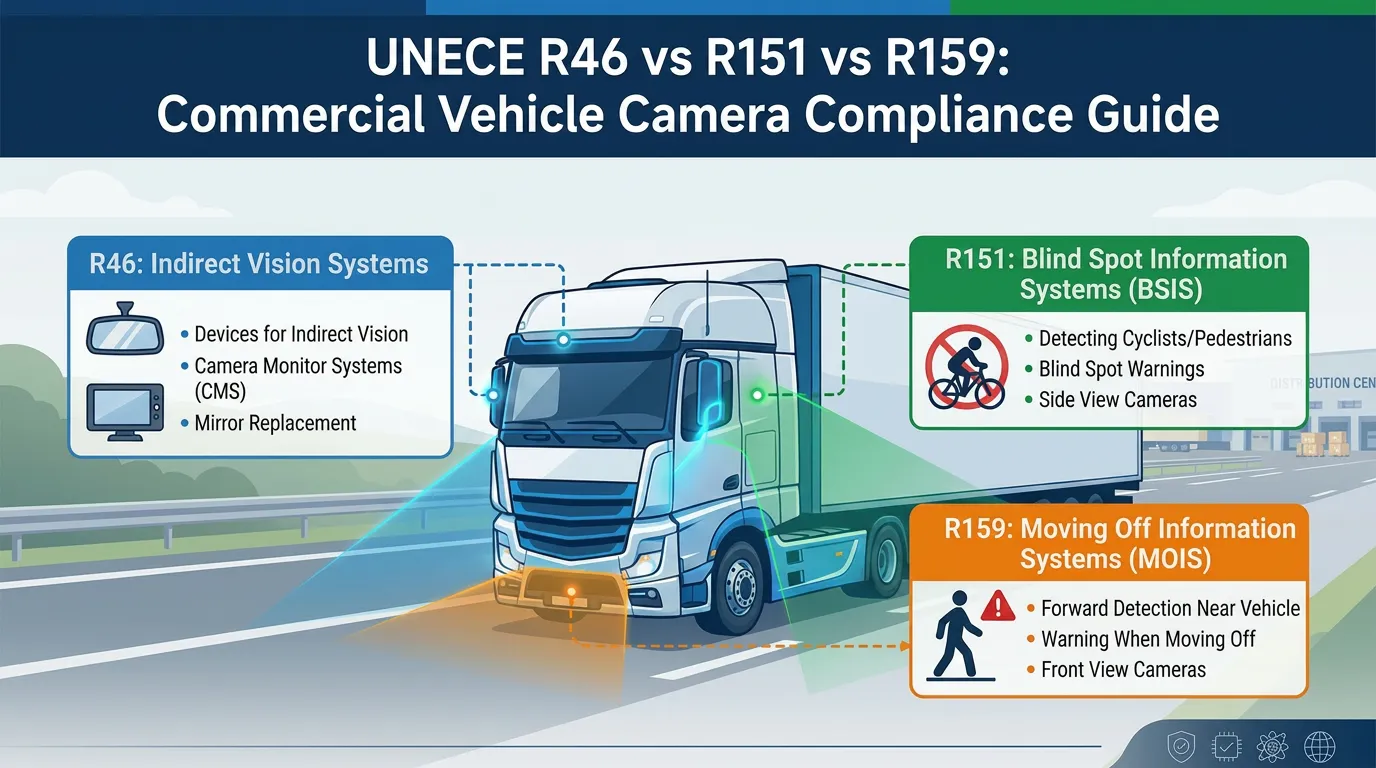
Many fleets hear terms like compliance, BSIS, MOIS, and camera monitor system, then assume they all mean the same thing. That confusion often leads to the wrong product choice, the wrong expectations, and the wrong project scope.
UNECE R46, R151, and R159 cover different functions. R46 focuses on indirect vision devices, including mirrors and camera-monitor systems. R151 focuses on blind spot information. R159 focuses on moving-off information in the close front area. They are related, but they are not interchangeable.
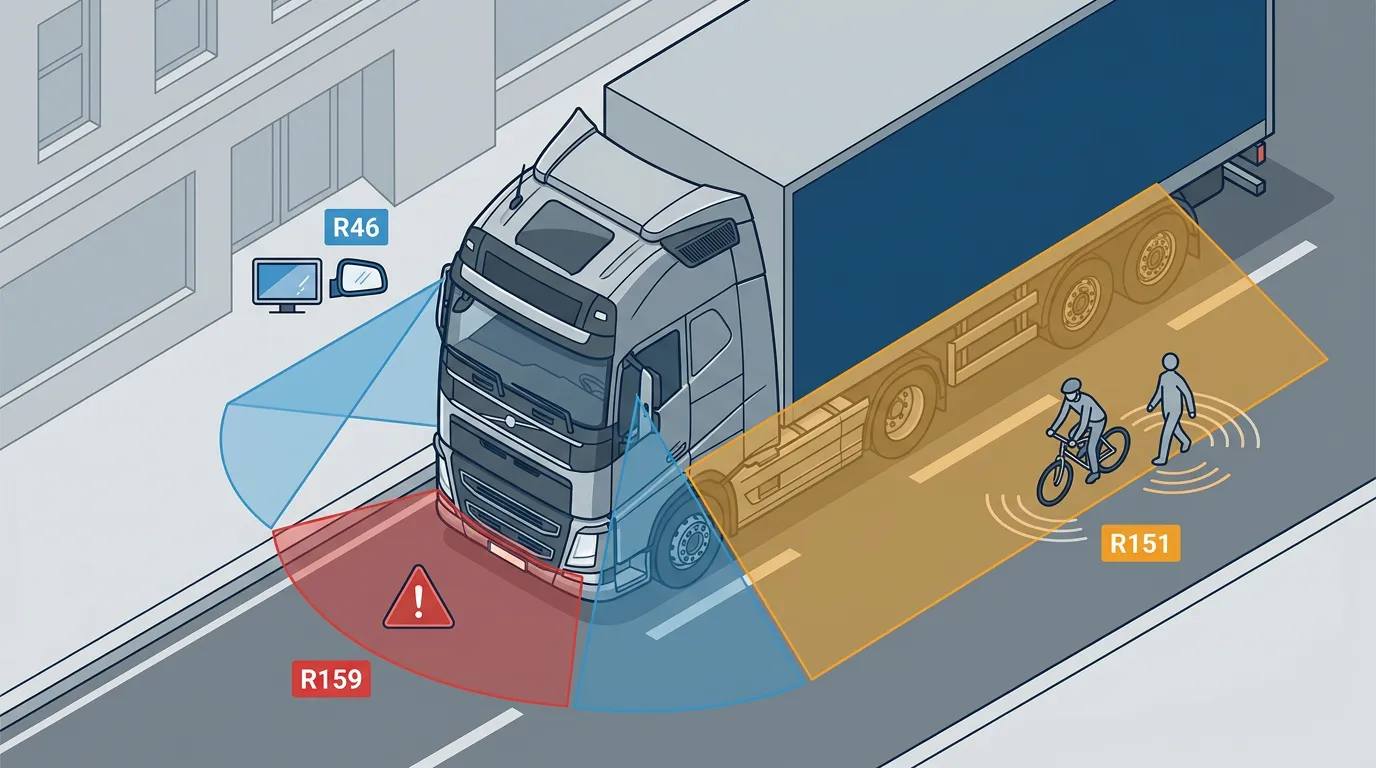
When buyers evaluate commercial vehicle camera systems, they often know these regulation numbers matter, but they do not always know where one ends and the next begins. That is understandable. All three regulations sit close to the same safety conversation, and all of them can connect to cameras, visibility, and vulnerable road user protection. But from a product and project point of view, they are not the same. The clearest way to understand them is not to ask which regulation is better, but to ask what exact safety function the vehicle is supposed to support.
Quick Answer: What Is the Difference Between R46, R151, and R159?
The difference is simple once the system role is clear:
- UNECE R46 = indirect vision, including mirrors and camera-monitor systems
- UNECE R151 = blind spot information for side-area risk
- UNECE R159 = moving-off information for the close front area
A practical way to read them is this:
- R46 asks how the driver gets the required indirect field of vision
- R151 asks how the system detects and informs the driver about side blind spot risk
- R159 asks how the system detects and informs the driver about close front moving-off risk
That is why a side camera is not automatically a BSIS system, and a front camera is not automatically a MOIS system.
What Does UNECE R46 Actually Cover?
UNECE R46 covers devices for indirect vision. In practical terms, it deals with how the driver gains the required indirect field of vision, whether through mirrors, camera-monitor systems, or other approved indirect vision devices. It is not the same thing as a blind spot warning regulation.
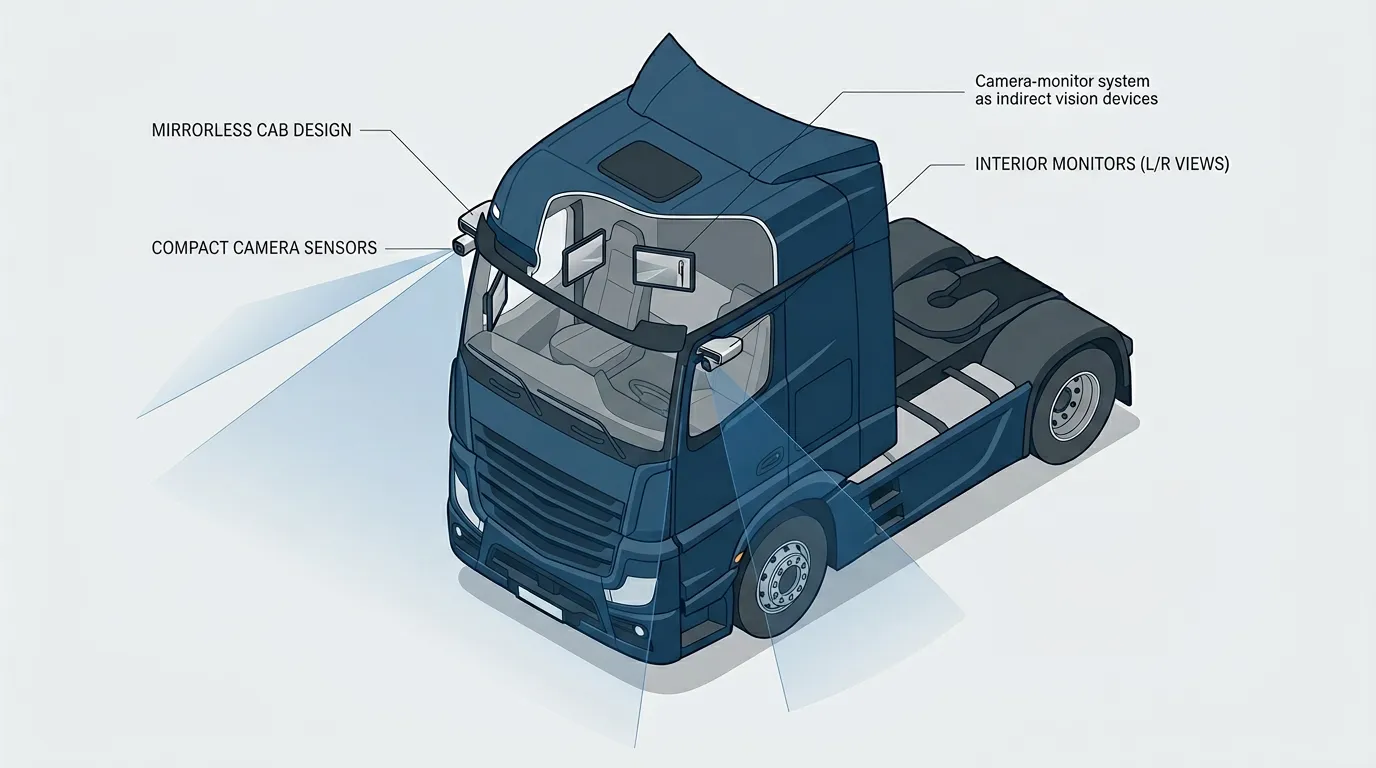
R46 is easiest to understand as a visibility regulation rather than a warning-system regulation. Its core logic is indirect vision. The driver needs a proper view of certain defined areas around the vehicle, and the regulation focuses on how those indirect views are provided. Traditionally, this was associated with mirrors. In more recent system design, camera-monitor systems also enter the discussion because they can serve as indirect vision devices when the required conditions are met.
That is why simply having cameras does not automatically mean a vehicle meets R46 in the relevant sense. A vehicle may have several cameras for support, recording, or convenience, but that does not automatically place the system in the same regulatory role as an indirect vision device under R46. The role matters. The performance expectation matters. The installation logic matters too.
For commercial vehicle projects, R46 becomes especially relevant when the discussion moves toward replacing or supporting mirror-based indirect vision with camera-monitor solutions. That is different from simply adding a reversing camera or a side support camera. If a buyer is still deciding which platform is suitable before discussing compliance, it also helps to review a broader fleet camera system selection guide first.
R46 at a Glance
| Regulation | Main purpose | Practical meaning |
|---|---|---|
| R46 | Indirect vision | Mirrors and camera-monitor systems for required fields of view |
| R151 | Blind spot information | Detection and driver information for side-area risk |
| R159 | Moving-off information | Detection and driver information for close front-area risk |
What Is UNECE R151 and Why Is It Not the Same as a Side Camera?
UNECE R151 covers the Blind Spot Information System, often called BSIS. In simple terms, it is about detecting certain road users in the relevant blind spot scenario and informing the driver. It is not just about showing a side image on a monitor.
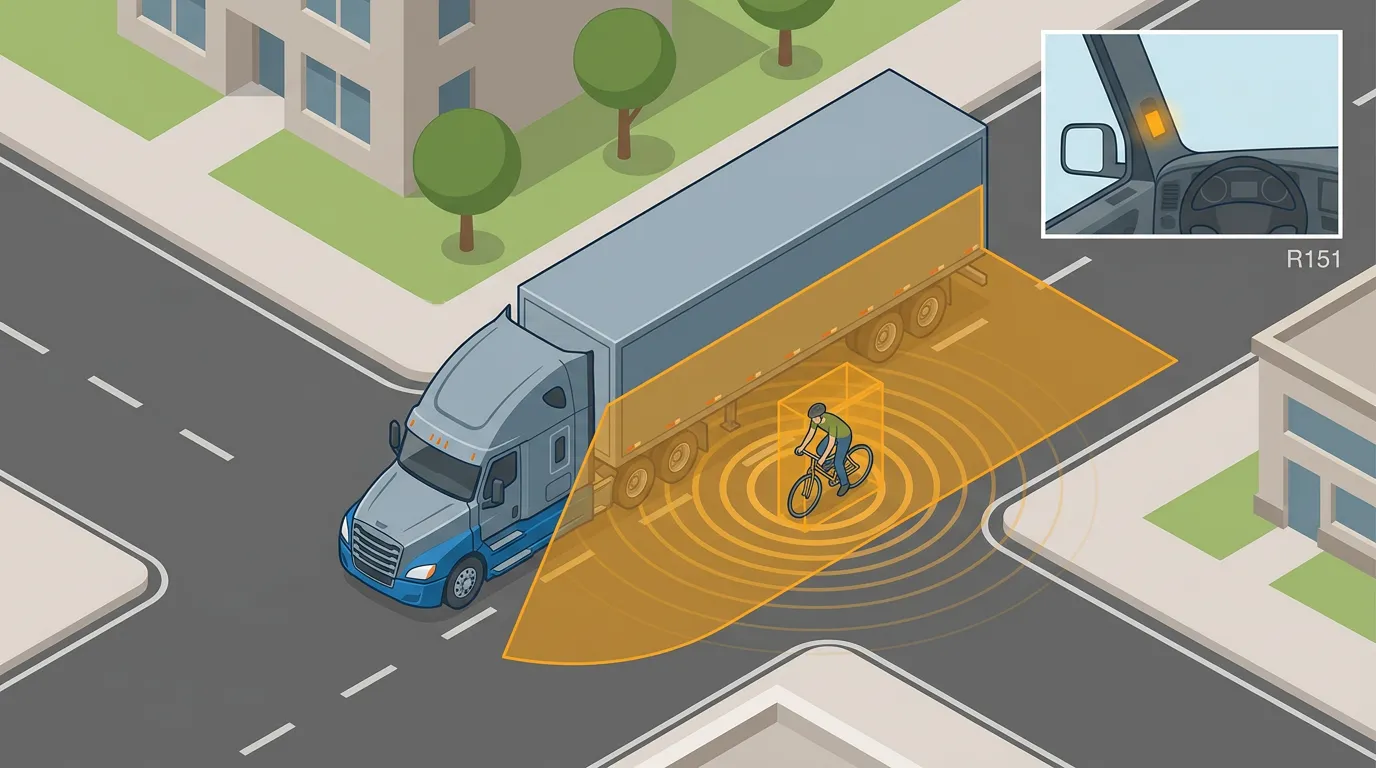
R151 becomes much clearer once seeing is separated from detecting and informing. A side camera helps the driver see an area. That can be very useful. But a BSIS under R151 is not only a viewing aid. It is a system with a defined safety purpose. It has to detect relevant road users under the intended conditions and provide information to the driver according to the system logic.
That distinction matters when products are compared. A standard side-view monitor system can still improve safety, and for some fleets that may be the right commercial choice. But it should not automatically be described as an R151 solution unless the product and vehicle application truly fit that function. Precision matters here because it protects trust and avoids overclaiming.
In real fleet work, R151 usually enters the discussion when the operator is concerned about side blind spot incidents, especially in turning scenarios involving vulnerable road users. At that point, the issue is no longer just where the side camera is mounted. It becomes a question of whether the system is acting as a true blind spot information function. If the project still needs the best visibility layout before detection logic is considered, a dedicated truck camera placement guide is also worth reviewing.
Side Camera vs R151 BSIS
| Question | Side camera system | R151 BSIS logic |
|---|---|---|
| Does it show the side area? | Yes, often | It may, but that is not the main point |
| Does it detect a relevant road user? | Not always | Yes, that is central |
| Does it inform the driver as a system function? | Sometimes, sometimes not | Yes |
| Is image display alone enough? | Sometimes for visibility support | No |
What Does UNECE R159 Mean for Front Close-Proximity Safety?
UNECE R159 covers the Moving Off Information System, or MOIS. In practical terms, it addresses detection and driver information for pedestrians and cyclists in the close-proximity forward area when the vehicle is moving off. It is not just about installing a front camera.
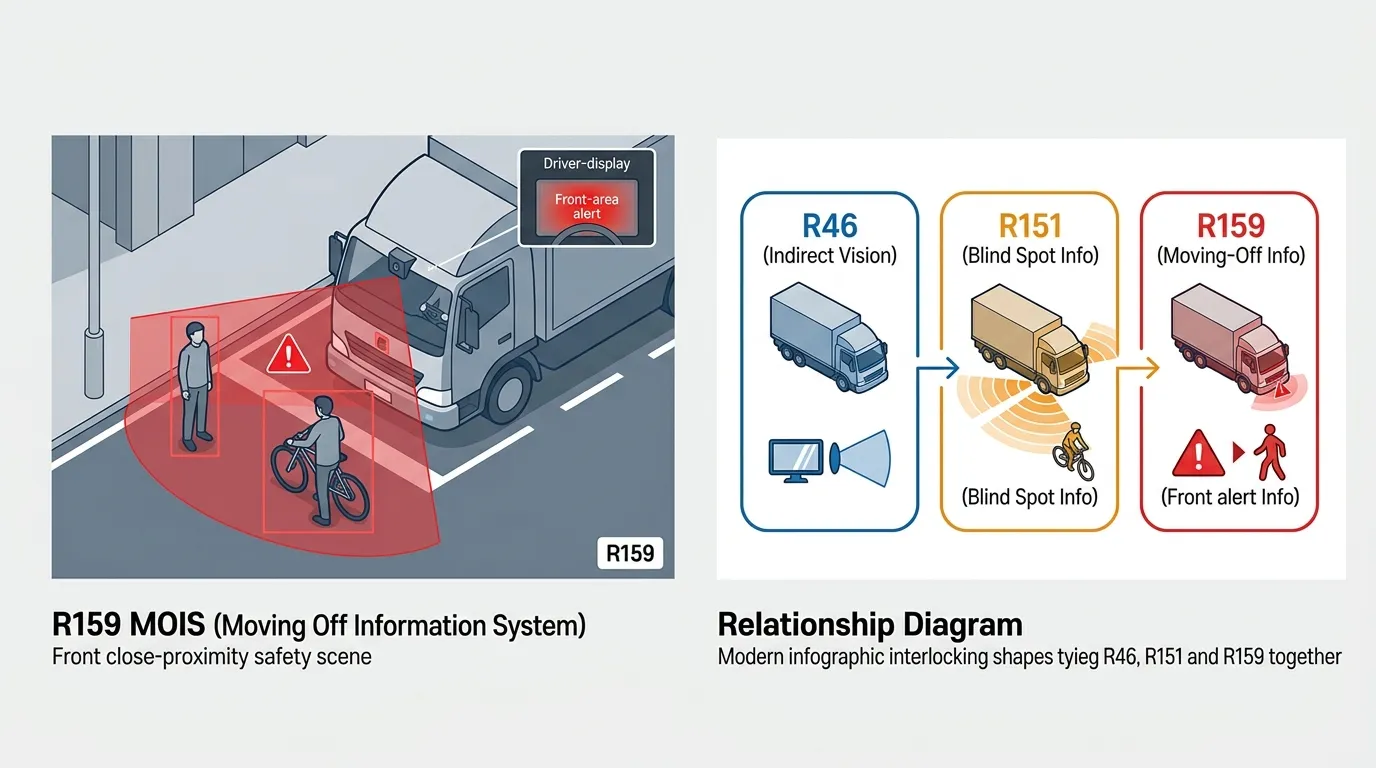
R159 is best understood as a front-area awareness function with a specific purpose. It is not intended to create a general-purpose front-view accessory. It is focused on the close-proximity area ahead of the vehicle where vulnerable road users may be difficult to see directly when the vehicle starts moving. That is why a front camera and an R159-oriented system should not be treated as the same thing.
A front camera can absolutely help with near-front awareness. In many commercial vehicle applications, it is a useful support tool. But usefulness alone is not the same as regulatory function. A moving-off information system has to perform as a detection and information system, not only as a video source.
This matters because many buyers use the term “MOIS camera” loosely. That is understandable from a market point of view, because cameras are visible and easy to describe. But if the project is truly driven by R159 requirements, the evaluation has to go beyond the camera and examine the full system role, detection purpose, and relevant operating conditions. If front coverage is still being defined, a separate truck camera placement guide can also help clarify the difference between visibility support and a moving-off information function.
Front Camera vs R159 MOIS
| Question | Front camera | R159 MOIS logic |
|---|---|---|
| Does it provide a forward image? | Yes | It may, but image alone is not enough |
| Does it target the close front area? | Sometimes | Yes |
| Does it detect relevant road users? | Not always | Yes, that is central |
| Is it mainly a viewing aid? | Often yes | No, it is an information system |
How Should Fleets Understand the Relationship Between R46, R151, and R159?
Fleets should understand R46, R151, and R159 as related but different layers of commercial vehicle safety. R46 is about indirect vision. R151 is about side blind spot information. R159 is about moving-off information in the close front area. A single vehicle project may involve more than one of these discussions, but the functions are still different.
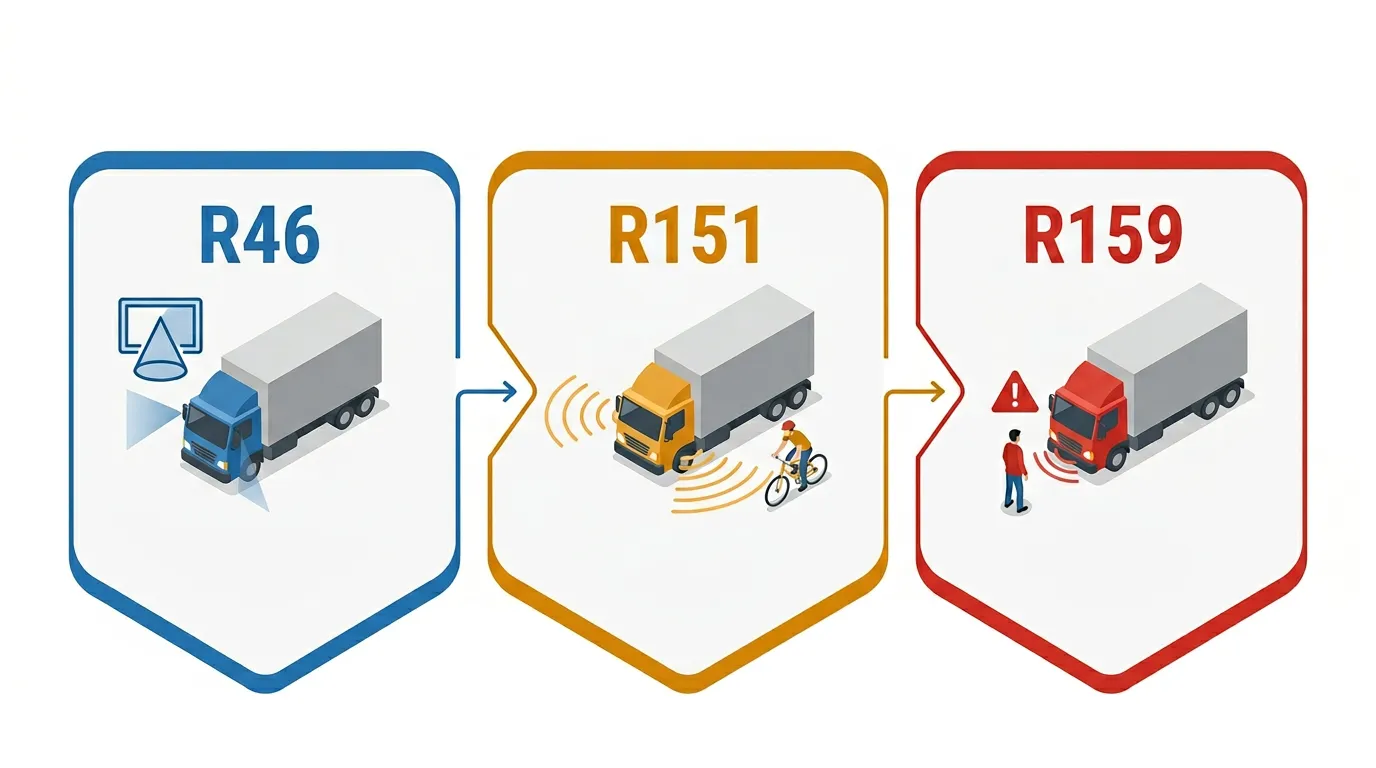
These regulations are not competing choices. They answer different safety questions:
- R46 asks how indirect vision is provided
- R151 asks how side blind spot risk is detected and signaled
- R159 asks how close front moving-off risk is detected and signaled
That is why the whole topic should not be reduced to “camera compliance.” Cameras may be part of the answer in more than one regulatory context, but their role is not identical in each case. In one project, the main discussion may be indirect vision support. In another, it may be side detection logic. In another, it may be close front moving-off awareness. The same hardware family may appear in all three conversations, but that does not remove the functional difference.
This distinction is important in content, sales, and technical communication. It helps suppliers explain products honestly, and it helps customers avoid buying a visibility aid while expecting a compliant warning-system outcome.
| Regulation | Safety question it answers | Typical market confusion |
|---|---|---|
| R46 | How is indirect vision provided? | “Any camera system is R46” |
| R151 | How is side blind spot risk detected and signaled? | “Any side camera is BSIS” |
| R159 | How is close front moving-off risk detected and signaled? | “Any front camera is MOIS” |
How Should I Talk About Compliance Without Overstating What the Product Does?
The safest way to talk about compliance is to describe the product’s actual role clearly. If it is a camera-monitor visibility aid, say that. If it is intended for a BSIS- or MOIS-related system discussion, say that carefully and precisely. Do not treat support functions, camera views, and full regulatory roles as identical.
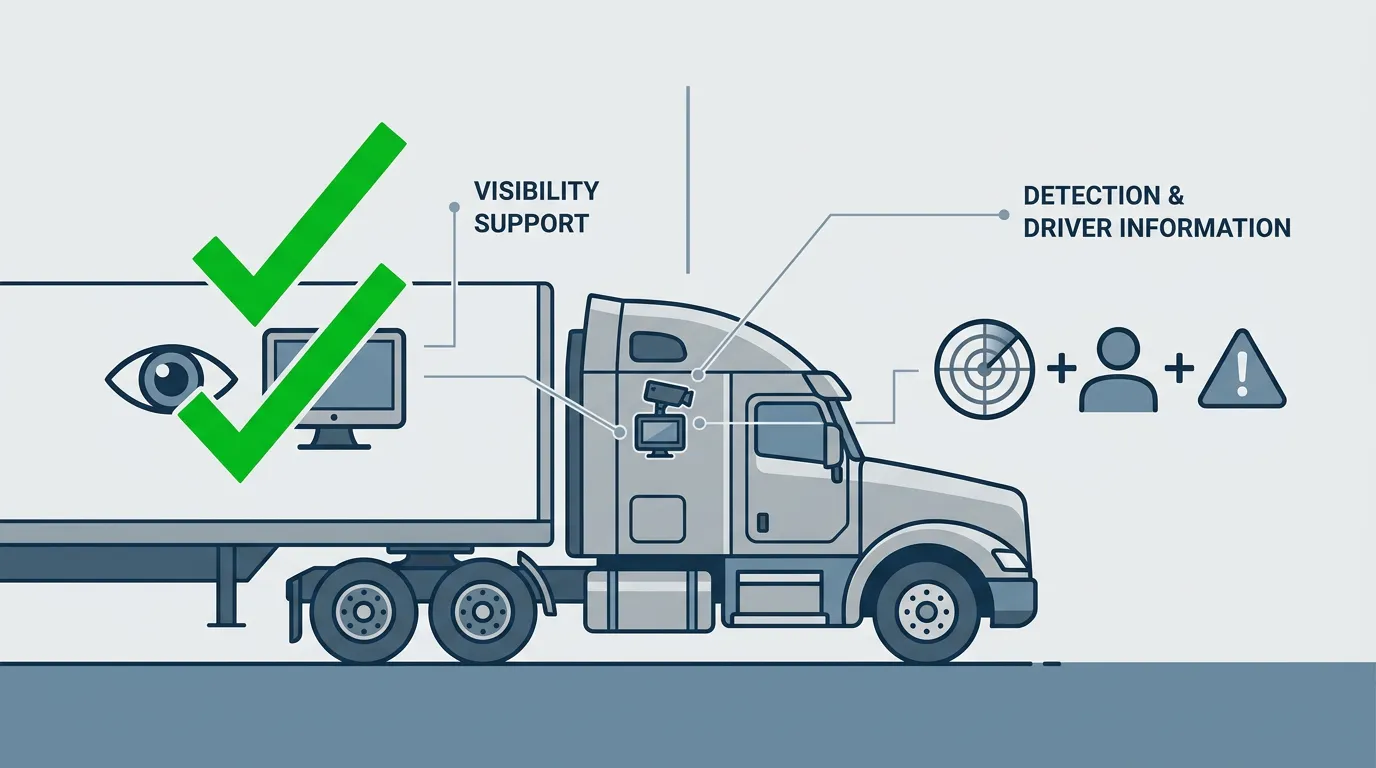
Using compliance language loosely may make a product sound stronger in the short term, but it creates long-term risk with serious buyers. Clear language is part of good commercial practice.
A side camera can support awareness, but that does not automatically make it an R151 system. A front camera can improve near-front visibility, but that does not automatically make it an R159 system. A camera-monitor layout can contribute to indirect vision, but that does not mean every aftermarket camera kit should be described as R46-compliant in the same way.
A better approach is to stay close to the real function. For example, it is more accurate to say a product:
- supports indirect vision discussion
- supports side visibility
- supports close front awareness
- supports multi-camera monitoring for commercial vehicles
- should be evaluated in the full vehicle system context
Serious buyers usually notice the difference between practical support language and overstated compliance language. Clear wording helps avoid confusion, reduces technical back-and-forth later, and makes the whole project easier to manage.
Better Compliance Wording
| Better wording | Why it helps |
|---|---|
| Supports indirect vision discussion | More precise than broad compliance claims |
| Supports blind spot visibility | Clear if the product is mainly a viewing aid |
| Supports close front awareness | Clear if the product is not a full MOIS claim |
| Intended for commercial vehicle safety support | Honest and flexible |
| To be evaluated in the full vehicle system context | Avoids overstatement |
Common Mistakes Buyers Make When Discussing Camera Compliance
The most common mistake is assuming that any camera-based product automatically performs the same role as a regulated system. That usually creates the wrong expectations from the start.
Other common mistakes include:
- treating any side camera as a BSIS solution
- treating any front camera as a MOIS solution
- assuming any camera monitor layout automatically fills the same role as an R46 indirect vision device
- using compliance language loosely in sales or marketing materials
- evaluating camera hardware without first defining the actual safety function required
In practice, compliance discussions become much easier once the project begins with one simple question: what exact safety function is the vehicle supposed to support?
Conclusion
UNECE R46, R151, and R159 are not three different ways of saying the same thing.
R46 is about indirect vision.
R151 is about blind spot information.
R159 is about moving-off information near the front of the vehicle.
Once those functions are separated clearly, it becomes much easier to choose the right camera system, describe it honestly, and build the right commercial vehicle safety solution.
FAQ
What does UNECE R46 cover?
UNECE R46 covers indirect vision devices, including mirrors and camera-monitor systems used to provide the required indirect field of vision.
Is a side camera the same as UNECE R151 BSIS?
No. A side camera may help the driver see the side area, but UNECE R151 is about detecting relevant road users and informing the driver as a blind spot information function.
Is a front camera the same as UNECE R159 MOIS?
No. A front camera may improve near-front visibility, but UNECE R159 is about detecting and informing the driver about relevant road users in the close front moving-off area.
Can one vehicle involve R46, R151, and R159 at the same time?
Yes. A single vehicle project may involve more than one of these regulatory discussions, but each regulation still covers a different safety function.
How should suppliers talk about compliance more accurately?
Suppliers should describe the product’s real role clearly, avoid overstating support functions as full compliance roles, and explain whether the product is a visibility aid, a detection-and-information function, or part of a broader vehicle system evaluation.

 Arabic
  English
  Spanish
  Japanese
  German
  Dutch
Dutch