
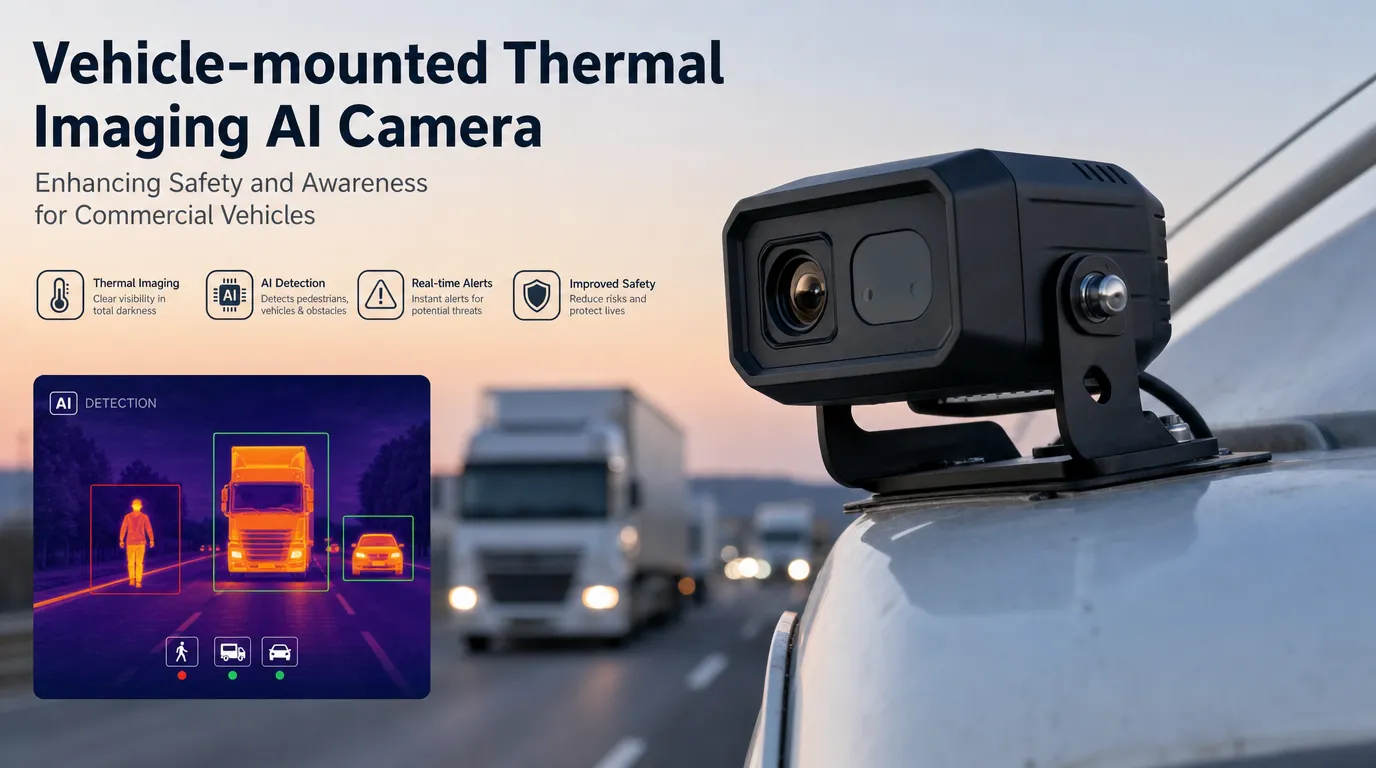
Vehicle-mounted thermal cameras are becoming more common in commercial vehicle safety systems, especially on trucks, forklifts, construction machinery, buses, mining vehicles and other industrial vehicles that often work at night or in low-visibility environments.
Unlike a standard visible-light vehicle camera, a thermal camera detects heat signatures from pedestrians, vehicles, animals and obstacles. This makes it useful in situations where normal cameras may struggle, such as darkness, smoke, dust, fog, glare or poor lighting conditions.
For fleet operators, distributors and vehicle safety solution providers, choosing the right vehicle-mounted thermal camera manufacturer in China is not only about price. Buyers also need to look at image quality, dual-light camera design, AI detection ability, waterproof performance, vibration resistance, alarm output, installation flexibility and long-term technical support.
This guide introduces common types of vehicle-mounted thermal camera suppliers in China and explains what buyers should check before choosing a thermal imaging camera solution for commercial vehicles.
For buyers looking for a ready-to-use solution, VST also provides a dual-light thermal imaging AI vehicle camera for trucks, forklifts, construction machinery and industrial vehicles.
What Is a Vehicle-Mounted Thermal Camera?
A vehicle-mounted thermal camera is a camera system installed on a vehicle to detect heat instead of relying only on visible light.
In a vehicle safety application, the camera can help the driver see pedestrians, vehicles, animals or objects that may not be clearly visible through a normal camera, especially at night or in poor weather. Some thermal cameras are used as a simple night vision aid, while more advanced systems combine thermal imaging with visible-light images and AI detection.
For commercial vehicles, thermal cameras are usually installed on the front, rear or side of the vehicle, depending on the risk area. They can be connected to an in-cab monitor, MDVR, warning light, buzzer or AI detection system.
A basic thermal camera helps improve visibility. A thermal imaging AI vehicle camera goes one step further by detecting pedestrians or vehicles and giving alerts when a risk is found.
Why Thermal Imaging Cameras Are Used on Commercial Vehicles
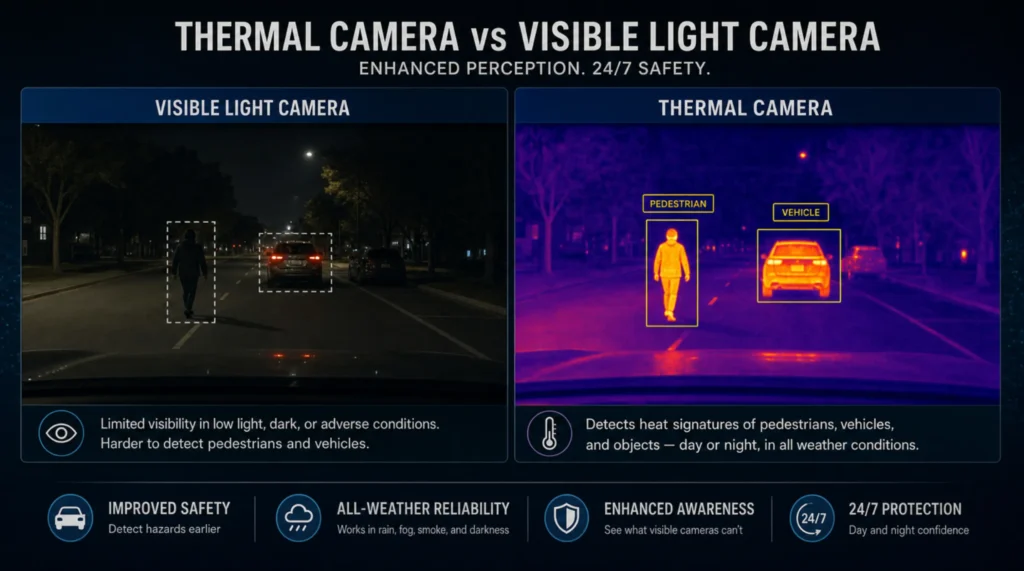
Commercial vehicles often work in environments where visibility is not stable. A truck may drive at night. A forklift may operate in a dim warehouse. A construction vehicle may work in dust, rain or poor lighting. In these situations, a normal camera can still be useful, but it may not always give the driver enough information.
Thermal imaging cameras are used because they can detect heat differences. A pedestrian, vehicle engine, animal or warm object can appear clearly in the thermal image, even when the background is dark.
For commercial vehicle safety, thermal cameras are mainly useful in the following situations:
- Night driving or low-light operation
- Blind spot monitoring around large vehicles
- Pedestrian detection near forklifts or industrial vehicles
- Construction site safety
- Mining and off-road vehicle operation
- Fleet safety upgrades
- Harsh environments with dust, smoke or poor visibility
Thermal cameras do not replace normal cameras in every case. In many vehicle projects, the best solution is a dual-light camera that combines visible-light imaging and thermal imaging. The visible-light image gives more detail, while the thermal image helps detect people or obstacles in difficult lighting conditions.
Top 10 Vehicle-Mounted Thermal Camera Manufacturers in China
China has a strong supply chain for vehicle cameras, infrared thermal imaging modules, AI cameras, MDVR systems and commercial vehicle safety products.
Some suppliers focus on complete vehicle safety systems, while others focus more on infrared modules, thermal imaging devices, security cameras or industrial inspection products. For commercial vehicle projects, buyers should not only compare the thermal camera itself, but also check whether the supplier understands vehicle installation, waterproof design, vibration resistance, video output, alarm connection and OEM/ODM support.
The following manufacturers can be used as a reference for buyers who are comparing vehicle-mounted thermal camera suppliers in China. This list is not ranked by market share. Buyers should review the actual product functions, application experience and technical support before choosing a supplier.
1. SHENZHEN VISIONSAFETYS TECHNOLOGY CO., LTD.
Location: Shenzhen, Guangdong, China
Supplier Type: Commercial vehicle camera and AI vehicle safety solution provider
Main Product Areas: Vehicle-mounted thermal cameras, dual-light thermal imaging AI cameras, vehicle monitors, AI detection cameras, wireless camera systems and blind spot detection systems
Suitable Applications: Trucks, forklifts, construction machinery, warehouse vehicles, buses, cranes, mining vehicles and industrial vehicles
Key Strengths: Vehicle safety application experience, dual-light thermal imaging, AI pedestrian and vehicle detection, waterproof vehicle camera design, flexible OEM/ODM support and system integration support
SHENZHEN VISIONSAFETYS TECHNOLOGY CO., LTD., also known as VST Tech, focuses on commercial vehicle safety camera systems and customized vehicle monitoring solutions.
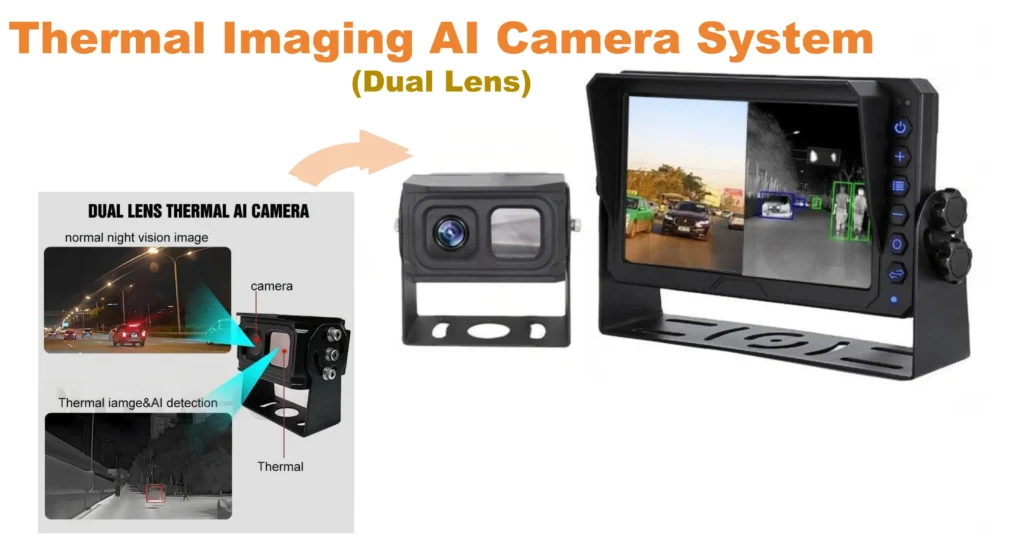
For thermal imaging applications, VST provides vehicle-mounted thermal camera solutions designed for trucks, forklifts, construction machinery, warehouse vehicles and other industrial vehicles. Its dual-light thermal imaging AI camera combines visible-light imaging, thermal imaging and AI detection, making it suitable for projects where drivers need better visibility and pedestrian detection in low-light or complex working environments.
Compared with suppliers that mainly focus on general thermal imaging products, VST is more focused on real vehicle applications. This can be helpful for buyers who need camera matching, monitor connection, alarm output, cable customization, installation support or OEM/ODM cooperation for commercial vehicle safety projects.
2. Stonkam Co., Ltd.
Location: Guangzhou, Guangdong, China
Supplier Type: Vehicle monitoring and vehicle safety system supplier
Main Product Areas: Vehicle cameras, monitors, mobile DVR systems, thermal night vision cameras, radar systems and safety warning solutions
Suitable Applications: Trucks, buses, forklifts, construction machinery, agricultural vehicles, trailers and commercial fleets
Key Strengths: Vehicle camera system experience, wide product range, commercial vehicle applications and integrated safety solutions
Stonkam Co., Ltd. has many years of experience in vehicle monitoring and safety products. Its product range covers vehicle cameras, monitors, mobile DVR systems, radar warning products and other vehicle safety solutions.
For buyers looking for vehicle-mounted thermal camera manufacturers in China, Stonkam can be considered when the project requires a complete vehicle monitoring system rather than only a single thermal camera. Its experience in commercial vehicle camera systems can be useful for applications such as reversing safety, blind spot monitoring, night vision assistance and multi-camera vehicle monitoring.
Before choosing a specific model, buyers should confirm the thermal camera resolution, video output, monitor compatibility, waterproof level, mounting method and whether the system supports the required vehicle installation environment.
3. Shenzhen Yuweixin Electronic Co., Ltd.
Location: Shenzhen, Guangdong, China
Supplier Type: Electronic safety device and thermal imaging product supplier
Main Product Areas: Thermal cameras, infrared imaging modules, electronic safety devices and related imaging products
Suitable Applications: General surveillance, commercial vehicles, industrial monitoring and safety-related projects
Key Strengths: Cost-effective product options, infrared imaging products and flexible supply capability
Shenzhen Yuweixin Electronic Co., Ltd. provides thermal camera and infrared imaging related products for different application scenarios.
For buyers comparing vehicle-mounted thermal camera suppliers, Yuweixin may be suitable for projects that need cost-effective thermal imaging products or infrared modules. Its products can be considered for general safety, monitoring or vehicle-related applications where the project does not require a highly customized system.
For commercial vehicle use, buyers should carefully check whether the selected model is suitable for outdoor vehicle installation. Important details include waterproof protection, vibration resistance, power input, video output, bracket design and compatibility with vehicle monitors or recording systems.
4. Xinfrared
Location: Hangzhou, Zhejiang, China
Supplier Type: Thermal imaging product and infrared technology supplier
Main Product Areas: Portable thermal cameras, infrared modules, thermal imaging systems and vehicle-related thermal imaging products
Suitable Applications: Industrial inspection, security, outdoor monitoring, vehicle-related thermal imaging and advanced imaging projects
Key Strengths: Thermal imaging technology, compact product design, high sensitivity options and infrared module development
Xinfrared focuses on thermal imaging technology and infrared imaging products. Its product line includes portable thermal cameras, infrared modules and thermal imaging systems for different professional applications.
For vehicle-mounted thermal camera projects, Xinfrared may be considered when the buyer needs thermal imaging technology, compact infrared modules or thermal camera products for integration into a larger system.
If the project is for trucks, forklifts, construction machinery or other commercial vehicles, buyers should confirm whether the product is designed for real vehicle environments. The key points to check include waterproof housing, vibration resistance, operating temperature, output signal, mounting method and long-term stability.
5. Argus Information Technology Co., Ltd.
Location: Shanghai, China
Supplier Type: Imaging technology and AI-based visual solution provider
Main Product Areas: Industrial cameras, thermal imaging products, AI imaging systems and vehicle-related visual solutions
Suitable Applications: Industrial monitoring, security, automotive-related imaging, smart transportation and real-time visual analysis projects
Key Strengths: Imaging system development, AI analysis, edge computing and real-time image processing
Argus Information Technology Co., Ltd. provides imaging solutions for industrial, security and automotive-related applications. Its product direction includes thermal imaging and AI-based visual analysis.
For buyers comparing vehicle-mounted thermal camera manufacturers, Argus may be relevant when the project needs thermal imaging combined with AI analysis or real-time image processing. This can be useful in applications where the camera is not only used for viewing, but also for detection, analysis or warning.
For commercial vehicle projects, buyers should check the full system compatibility, including camera output, AI detection functions, vehicle monitor connection, waterproof protection, vibration resistance and installation support.
6. WUHAN GLOBAL SENSOR TECHNOLOGY CO., LTD.
Location: Wuhan, Hubei, China
Supplier Type: Infrared detector, thermal sensor and thermal imaging module supplier
Main Product Areas: Infrared detectors, thermal sensor modules, thermal imaging cores and vehicle-related thermal imaging components
Suitable Applications: Thermal camera manufacturing, security, industrial monitoring, vehicle thermal imaging integration and infrared system development
Key Strengths: Infrared sensor technology, thermal imaging core modules and component-level supply capability
WUHAN GLOBAL SENSOR TECHNOLOGY CO., LTD. specializes in infrared sensors, thermal imaging modules and related core components. This type of supplier is especially relevant for manufacturers or system integrators who need thermal imaging modules rather than only finished camera products.
For vehicle-mounted thermal camera projects, Global Sensor Technology may be suitable when buyers need infrared cores, sensors or thermal modules for product development or system integration.
If the buyer needs a complete ready-to-install commercial vehicle camera system, it is important to confirm whether the supplier can provide housing design, vehicle-grade protection, video output, mounting structure, cable connection and application support.
7. Hangzhou Chenquan Tech Co., Ltd.
Location: Hangzhou, Zhejiang, China
Supplier Type: Infrared imaging and industrial thermal solution supplier
Main Product Areas: Vehicle-mounted thermal cameras, industrial thermal imaging solutions, infrared monitoring products and thermal detection systems
Suitable Applications: Industrial monitoring, commercial vehicles, safety monitoring, inspection and harsh-environment applications
Key Strengths: Infrared imaging products, industrial application experience, thermal detection capability and durable product design
Hangzhou Chenquan Tech Co., Ltd. focuses on infrared imaging technology and thermal imaging solutions for industrial and commercial applications.
For buyers looking for vehicle-mounted thermal camera suppliers, Chenquan Tech may be considered for projects that require thermal imaging products in challenging environments. Its industrial background can be useful when durability and stable image performance are important.
For vehicle use, buyers should still confirm whether the selected model supports the required video output, waterproof level, vibration resistance, bracket installation and monitor or MDVR compatibility.
8. MH Technology Group
Location: Shenzhen, Guangdong, China
Supplier Type: Intelligent imaging and smart video solution provider
Main Product Areas: Vehicle-mounted thermal cameras, security imaging products, intelligent video systems and traffic monitoring solutions
Suitable Applications: Smart city, traffic management, security monitoring, vehicle-related imaging and urban safety projects
Key Strengths: Intelligent imaging, AI-based visual processing, traffic-related applications and system integration capability
MH Technology Group develops intelligent imaging products and visual solutions for different security, traffic and monitoring applications.
For vehicle-mounted thermal camera buyers, MH Technology Group may be relevant when the project is connected with smart transportation, traffic monitoring or intelligent video analysis. Its experience in AI and imaging systems can support projects that require more than basic thermal viewing.
If the camera will be installed on commercial vehicles, buyers should confirm whether the product is suitable for moving vehicle environments, including power supply, anti-vibration design, waterproof protection, connector type and monitor compatibility.
9. Shenzhen Dianyang Technology Co., Ltd.
Location: Shenzhen, Guangdong, China
Supplier Type: Infrared thermal imaging product manufacturer
Main Product Areas: Handheld thermal cameras, PCBA thermal cameras, smartphone thermal cameras, NDT testing equipment, thermal night vision products and infrared imaging devices
Suitable Applications: Industrial inspection, electronics testing, thermal analysis, night vision, general monitoring and special equipment applications
Key Strengths: Infrared thermal imaging product range, practical product design and cost-effective thermal imaging options
Shenzhen Dianyang Technology Co., Ltd. manufactures infrared thermal imaging products for different use cases, including inspection, testing, night vision and general thermal imaging applications.
Although its product range is not limited to vehicle-mounted thermal cameras, the company can be included in a supplier comparison when buyers are looking for infrared thermal imaging products or thermal imaging devices that may be adapted for specific projects.
For commercial vehicle safety applications, buyers should check whether the product is designed for continuous vehicle use. Important points include waterproof housing, vibration resistance, video output, power input, installation bracket and whether the camera can connect with a vehicle monitor, MDVR or alarm system.
10. Shenzhen Yuxunion Electronics Technology Co., Ltd.
Location: Shenzhen, Guangdong, China
Supplier Type: Security, surveillance and vehicle monitoring product supplier
Main Product Areas: Vehicle-mounted monitoring systems, thermal imaging devices, security cameras, surveillance products and AI-related visual systems
Suitable Applications: Security monitoring, vehicle monitoring, commercial vehicles, surveillance projects and safety warning applications
Key Strengths: Security system experience, vehicle monitoring products, thermal imaging options and AI-related surveillance functions
Shenzhen Yuxunion Electronics Technology Co., Ltd. provides security, surveillance and vehicle monitoring products for domestic and international customers.
For buyers comparing thermal camera suppliers in China, Yuxunion may be considered when the project requires thermal imaging together with monitoring or surveillance functions. Its product direction may be suitable for vehicle monitoring, security applications or general safety systems.
For commercial vehicle projects, buyers should confirm the actual vehicle installation suitability before selection. Key details include waterproof level, shock resistance, power input, video signal, night vision performance, AI detection function and system compatibility.
How to Compare Vehicle-Mounted Thermal Camera Manufacturers
Before comparing different suppliers, buyers should review several key factors that affect product performance, system compatibility and long-term project support.
A good vehicle-mounted thermal camera manufacturer should not only provide a thermal camera. It should also understand how the camera will be installed, how the driver will use it, what type of vehicle it will be used on and what kind of warning or display system is needed.
The following factors can help buyers compare different suppliers:
Product Focus
Some suppliers focus mainly on general thermal cameras. Others focus on vehicle cameras, AI cameras or fleet safety systems. For vehicle-mounted applications, it is usually better to choose a supplier that understands commercial vehicle installation and vehicle safety use cases.
System Compatibility
Check whether the camera can work with your existing monitor, MDVR, AI box, warning light, buzzer or fleet system. For B2B projects, compatibility is often more important than the camera itself.
Customization Ability
For distributors and system integrators, customization may be necessary. This can include cable length, connector type, mounting bracket, video output, logo, packaging or software-related settings.
Technical Support
Thermal camera projects may require more support than standard vehicle cameras. Buyers should check whether the supplier can provide wiring guidance, installation advice, testing support and clear communication during the project.
Real Vehicle Application Experience
A thermal camera that works well in a lab or fixed security system may not always be suitable for a moving vehicle. Vehicle projects need to consider vibration, water, dust, temperature changes, cable protection and long-term operation.
Key Features to Check Before Choosing a Thermal Imaging AI Vehicle Camera
When choosing a thermal imaging AI vehicle camera, the specification sheet alone is not enough. Buyers should understand which features actually affect vehicle safety performance.
1. Thermal Image Quality
Thermal image quality affects how clearly the system can show pedestrians, vehicles or obstacles. Buyers should check thermal resolution, image clarity, NETD sensitivity and frame rate.
A higher thermal resolution usually provides more detail, while better sensitivity helps the camera detect smaller temperature differences. For vehicle safety, the image should be clear enough for the driver or AI system to recognize possible risks.
2. Dual-Light Camera Design
For commercial vehicles, a dual-light camera is often more practical than a thermal-only camera.
The visible-light image helps the driver understand the actual scene, while the thermal image helps identify heat sources in darkness or poor visibility. When both images are available, the system can provide better overall awareness.
3. AI Pedestrian and Vehicle Detection
If the camera is used for blind spot safety, forklift safety or construction vehicle operation, AI detection can be very useful.
Buyers should check whether the system supports pedestrian detection, vehicle detection, adjustable detection zones, sensitivity settings and alarm output. It is also important to test the detection performance in the real working environment, not only in a demo video.
If the project also requires visible-light AI detection, buyers can compare a thermal imaging AI camera with a standard AI pedestrian detection camera.
4. Waterproof and Dustproof Protection
Vehicle cameras are often exposed to rain, dust, washing, mud and outdoor environments. For this reason, waterproof and dustproof protection is important.
Buyers should check the camera housing, lens protection, connector design and cable sealing. For heavy-duty vehicle use, a higher protection level is usually preferred.
5. Vibration Resistance
Commercial vehicles may operate on rough roads, construction sites, warehouses, ports or mining areas. The camera should be able to handle vibration and shock during long-term use.
For forklifts, construction machinery and off-road vehicles, buyers should pay special attention to the bracket, connector and internal structure of the camera.
6. Video Output and Monitor Compatibility
Before choosing a camera, confirm how the image will be displayed or recorded.
Some projects may require AHD output to connect with a vehicle monitor. Others may need CVBS, digital signal, MDVR connection or AI box integration. If the camera cannot match the existing system, installation will become more complicated.
7. Alarm Output
For safety applications, the camera should not only show an image. In many projects, an alarm output is also needed.
This can be used to trigger a buzzer, warning light, monitor alert or external safety device. For forklifts and industrial vehicles, a clear warning can help the driver react faster.
8. OEM and ODM Support
For distributors, equipment suppliers and fleet safety companies, OEM/ODM support can be important.
This may include customized logo, cable length, connector type, bracket design, packaging, function settings or product combination. A flexible supplier can make the project easier to launch and support.
Vehicle-Mounted Thermal Camera Applications
Thermal cameras can be used in many industries, but for commercial vehicle safety, the most common applications are related to night visibility, blind spot detection and pedestrian safety.
Truck Night Driving Safety
Trucks often operate at night or in poor lighting conditions. A thermal camera can help the driver identify pedestrians, animals, parked vehicles or obstacles earlier than a normal visible-light camera in some situations.
For long-distance trucks, logistics vehicles and heavy-duty vehicles, thermal imaging can be used as an additional safety aid, especially in dark roads, rural areas or low-visibility environments.
Forklift and Warehouse Vehicle Safety
Forklifts often work close to pedestrians, pallets, racks and other vehicles. In busy warehouses or loading areas, blind spots can create safety risks.
A thermal imaging AI camera can help detect pedestrians around the vehicle, especially in areas where lighting is not stable or where workers may move behind obstacles.
For forklift safety projects, buyers should pay attention to detection distance, camera mounting position, alarm method and whether the system can work reliably at low vehicle speeds.
Construction Machinery Safety
Construction vehicles often operate in dust, mud, low light and complex jobsite conditions. Drivers may have limited visibility around large machines.
Thermal cameras can help improve awareness around construction machinery, especially when combined with a monitor or AI detection system. They can be used on excavators, loaders, cranes, road machinery and other heavy equipment.
Mining and Heavy-Duty Vehicles
Mining vehicles and heavy-duty industrial vehicles often work in harsh environments. Low light, dust and large blind spots can make operation more difficult.
Thermal imaging cameras can support night operation and obstacle awareness for mining trucks, off-road vehicles and heavy machinery. For these applications, durability, waterproof protection and vibration resistance are very important.
Fleet Safety and Driver Assistance
For fleet safety projects, thermal cameras can be used together with other vehicle safety systems such as AI cameras, MDVR, monitors, warning lights or radar sensors. For fleets that also need driver behavior monitoring, ADAS or remote video management, a 4G AI dash cam for commercial vehicles may be used together with thermal imaging or other vehicle camera systems.
The goal is not only to record video, but also to help the driver notice risks earlier and reduce blind spot accidents. For fleet operators, this can support safer driving and better vehicle management.
Thermal Camera vs Visible Light Camera for Vehicle Safety
A thermal camera and a normal visible-light vehicle camera are not the same. Each has its own advantages. In many commercial vehicle projects, the best solution depends on the working environment.
| Main Detection Method | Detects heat signatures | Captures visible images |
| Night Performance | Strong in darkness | Requires light or IR support |
| Fog / Smoke / Dust | Can provide better visibility in some low-visibility conditions | More easily affected by poor visibility |
| Pedestrian Detection | Suitable for heat-based pedestrian detection | Depends on lighting and image clarity |
| Image Detail | Lower visual detail | Higher visual detail |
| Best Use | Night driving, blind spot safety and harsh environments | Daytime monitoring, reversing and general vehicle camera use |
| Recommended Solution | Thermal + visible-light dual-camera system | Standard AHD camera or AI camera system |
For daytime monitoring, reversing and general rear visibility, a standard backup camera for commercial vehicles may still be the more practical choice.
For most commercial vehicle safety projects, a dual-light camera is a practical choice. It gives the driver a visible image for scene details and a thermal image for heat-based detection.
FAQ
What is a vehicle-mounted thermal camera?
A vehicle-mounted thermal camera is a camera system installed on a vehicle to detect heat signatures from pedestrians, vehicles, animals or obstacles. It is especially useful in darkness or low-visibility conditions.
What vehicles can use thermal imaging cameras?
Thermal imaging cameras can be used on trucks, forklifts, construction machinery, buses, mining vehicles, warehouse vehicles and other commercial or industrial vehicles.
What is the difference between a thermal camera and a normal vehicle camera?
A normal vehicle camera captures visible-light images. A thermal camera detects heat signatures. Thermal cameras are more useful in darkness, smoke, dust, fog or poor lighting, while normal cameras usually provide more visual detail.
Can a thermal camera detect pedestrians?
Yes. A thermal camera can detect heat signatures from pedestrians. When combined with AI detection, it can provide pedestrian detection alerts for vehicle safety applications.
Is a thermal imaging camera suitable for forklifts?
Yes. Thermal imaging AI cameras can be used on forklifts and warehouse vehicles to help detect pedestrians and reduce blind spot risks in busy working environments.
What should I check before choosing a thermal camera manufacturer?
Buyers should check thermal image quality, dual-light support, AI detection functions, waterproof rating, vibration resistance, system compatibility, alarm output and OEM/ODM support.
Do I need a thermal camera or a normal vehicle camera?
It depends on the working environment. If the vehicle mainly works in daylight or well-lit areas, a normal vehicle camera may be enough. If the vehicle works at night, in dust, fog, smoke or low-light conditions, a thermal camera or dual-light thermal imaging AI camera may be more suitable.
Looking for a Thermal Imaging AI Vehicle Camera Solution?
VST Tech provides a thermal imaging AI vehicle camera for commercial vehicles with visible-light + thermal imaging, pedestrian and vehicle detection, monitor connection and alarm output.
Our thermal imaging AI camera can support visible-light + thermal imaging, pedestrian and vehicle detection, monitor connection and alarm output. It is suitable for trucks, forklifts, construction machinery, warehouse vehicles, buses, mining vehicles and other industrial vehicles.
If you are looking for a thermal imaging AI camera for a fleet project, vehicle safety upgrade or OEM/ODM cooperation, contact us to discuss your application, detection requirements, camera configuration and installation needs.